
AI can write quickly, but speed alone does not create ranking-worthy content.
Most weak AI content fails before the first sentence is even written. The real problem is not always the AI tool. The problem is usually the brief.
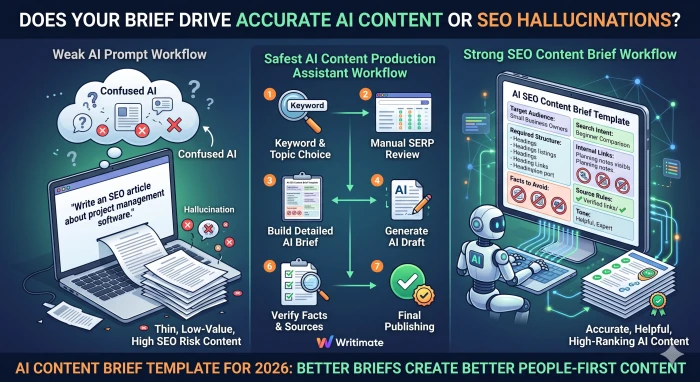
When you give AI a vague instruction like “write an SEO article about project management software,” the tool has to guess almost everything. It guesses the search intent, audience, structure, examples, facts, internal links, tone, and level of detail. Sometimes it guesses correctly. Many times, it creates a generic article that sounds confident but adds very little value.
That is where an SEO content brief for AI becomes important.
A strong brief tells AI what the article should achieve, who it is for, what facts to include, what facts to avoid, which headings are required, which internal links should be added, what tone to use, and how the final draft should be checked before publishing.
In simple words:
- Better briefs create better AI content. Weak briefs create thin content, hallucinations, and SEO risk.
- This guide gives you a complete SEO content brief template for AI. You can use it for blog posts, comparison articles, reviews, tutorials, landing pages, content clusters, and supporting SEO articles.
- It is designed for one goal: to help you create AI-assisted content that is more accurate, more useful, more original, and easier for a human editor to review.
What Is an SEO Content Brief for AI?
An SEO content brief for AI is a structured instruction document that guides an AI writing tool before it creates content.
A normal content brief may tell a writer the topic, keyword, word count, and a few headings. An AI content brief needs to go deeper because AI does not naturally understand your business, your audience, your editorial rules, or your website’s internal linking strategy unless you clearly provide that information.
A strong AI SEO brief usually includes:
- target keyword
- secondary keywords
- search intent
- audience profile
- SERP notes
- article angle
- required headings
- facts to include
- facts to avoid
- source rules
- internal links
- external reference instructions
- examples to add
- tone and style guidance
- formatting rules
- final QA checklist
The purpose is not to control every single sentence. The purpose is to reduce guesswork.
AI hallucinations often happen when the tool does not have enough verified information or clear boundaries. A good brief gives the AI a safer path to follow.
Why AI Content Needs a Stronger Brief Than Human Content
A human writer can use judgment while writing.
A good human writer may pause and ask:
- “Is this fact correct?”
- “Should I check the official source?”
- “Does this claim need a citation?”
- “Is this section actually useful?”
- “Will the reader understand this example?”
AI does not work the same way. It generates likely language based on the instruction it receives. If the instruction is weak, the output becomes weak.
That is why AI content needs a stronger brief than human-written content.
For example, this is a weak AI prompt:
- Write an article about email marketing tools.
This is not enough. The AI does not know whether the article is for beginners, agencies, ecommerce businesses, SaaS teams, or affiliate readers. It does not know whether the article should be a comparison, buying guide, tutorial, or review. It does not know which facts are verified and which claims should be avoided.
Now compare that with a stronger AI SEO brief:
- Write a beginner-friendly comparison guide for small business owners choosing email marketing tools. Focus on ease of use, pricing transparency, automation, templates, deliverability features, integrations, and customer support. Do not claim any platform is the “best overall” unless the reason is clearly explained. Do not mention pricing unless verified from official pricing pages. Include a comparison table, practical buying advice, and a final recommendation based on business type.
The second instruction is much safer. It gives AI a clear audience, structure, purpose, and fact boundary.
This is what a real AI SEO brief should do.
How Better Briefs Reduce AI Hallucinations
AI hallucination means the tool produces incorrect, invented, or unsupported information while sounding confident.
In SEO content, hallucinations can appear as:
- fake statistics
- wrong dates
- invented quotes
- outdated pricing
- fake product features
- incorrect company details
- unsupported “best” claims
- made-up examples
- false legal, finance, or health advice
- wrong Google policy explanations
This is dangerous because hallucinations often look believable. A reader may not immediately catch the error, but inaccurate content damages trust and can reduce the quality of your website over time.
A strong brief reduces hallucinations by telling AI exactly where it can and cannot make claims.
Weak instruction:
- Add some statistics.
Better instruction:
- Only include statistics that can be verified from official, primary, or trusted sources. If no verified statistic is available, do not invent a number. Use the placeholder [Statistic needed: verify source] for human review.
Weak instruction:
- Mention pricing.
Better instruction:
- Mention pricing only if it has been checked from the official pricing page. If pricing may change, use cautious wording and tell readers to check the official page for the latest details.
Weak instruction:
- Add examples.
Better instruction:
- Add practical examples based on common SEO workflows. Do not invent client names, revenue numbers, traffic results, rankings, or case studies unless they are provided.
The clearer your brief is, the less room AI has to guess.
What Google-Friendly AI Content Really Means
A Google-friendly AI article is not an article that simply “passes AI detection.”
That is the wrong target.
A better target is:
Would this page genuinely help the reader better than a generic article?
Google’s public guidance focuses on helpful, reliable, people-first content. It also warns against producing large amounts of unoriginal or low-value content mainly to manipulate rankings.
This means your AI SEO brief should not only say:
- “Use this keyword.”
It should also say:
- what the reader needs
- what problem the article solves
- what original value should be added
- which facts need verification
- which claims should be avoided
- how internal links should support the reader
- how the article should be reviewed before publishing
AI can help with speed, structure, and drafting. But the final article still needs editorial judgment.
A strong AI brief is not just an SEO tool. It is a quality control tool.
Complete SEO Content Brief Template for AI
Use the following template before asking AI to write any SEO article.
You can copy this section into your workflow and fill it out for each article.
1. Article Overview
Article Title:
[Add final article title]
Primary Keyword:
[Add main keyword]
Secondary Keywords:
[Add related keywords]
Content Type:
[Blog post, review, comparison, tutorial, guide, template, landing page, glossary, cluster page]
Search Intent:
[Informational, commercial, transactional, navigational, mixed]
Target Audience:
[Who is reading this?]
Reader’s Main Problem:
[What problem are they trying to solve?]
Main Promise of the Article:
[What should the reader understand or be able to do after reading?]
Recommended Word Count:
[Add ideal word count based on topic depth and SERP]
Content Difficulty:
[Beginner, intermediate, advanced]
Publishing Goal:
[Rank for keyword, support topical cluster, generate leads, educate users, support product page]
Example
Article Title: SEO Content Brief Template for AI: Write Briefs That Reduce Hallucinations
Primary Keyword: SEO content brief template for AI
Secondary Keywords: AI SEO content brief, SEO content brief AI template, reduce AI hallucinations, content optimization tools
Content Type: Template-based guide
Search Intent: Informational and practical
Target Audience: SEO writers, content teams, bloggers, agencies, and marketers using AI
Reader’s Main Problem: They want better AI content but keep getting generic or inaccurate drafts
Main Promise: The article gives a copy-ready brief template that improves AI output and reduces hallucinations
Recommended Word Count: 3,000 to 3,800 words
Content Difficulty: Beginner to intermediate
Publishing Goal: Support the AI SEO content cluster and attract readers looking for practical AI content workflows
2. Search Intent Notes
Search intent is the reason behind the keyword.
Before writing, define what the searcher wants. This is one of the most important parts of an AI content brief because AI can easily write a polished article that does not match the real intent.
For example, someone searching “SEO content brief template for AI” probably does not want a basic definition only. They want a usable template. They may also want to know how to reduce AI hallucinations, how to structure briefs, how to add keywords, and how to review the final draft.
Search Intent Template
The reader is looking for:
[Explain what the searcher wants]
The article must answer:
[List the most important questions]
The article should not over-focus on:
[List irrelevant or secondary angles]
The reader’s likely fear or pain point:
[Explain what they are worried about]
Best content format:
[Guide, checklist, template, tutorial, examples, comparison]
Example
The reader is looking for:
A practical SEO content brief template they can use with AI writing tools.
The article must answer:
What should an AI SEO brief include?
How does a brief reduce hallucinations?
How should keywords be added?
How should internal links be planned?
What facts should AI include and avoid?
What QA checklist should be used before publishing?
The article should not over-focus on:
Generic AI writing tool explanations or basic definitions of SEO.
The reader’s likely fear or pain point:
They are worried that AI content will be inaccurate, generic, or unsafe for SEO.
Best content format:
Template-based guide with examples, tables, and a final copy-ready brief.
3. SERP Notes
AI should not write without SERP context.
SERP notes help the AI understand what already ranks, what users expect, and where your article can be better.
You do not need to copy competitors. In fact, you should not. The goal is to understand the current content standard and then improve on it.
When reviewing the SERP, look for:
- common headings
- common questions
- content formats
- missing examples
- weak explanations
- outdated advice
- tool mentions
- template quality
- depth of information
- internal linking opportunities
SERP Notes Template
Top-ranking content types:
[Guides, templates, SaaS pages, listicles, blog posts]
Common headings in top results:
[Add repeated headings]
Common missing points:
[What competitors did not explain well]
Opportunity to improve:
[How your article will be better]
Required SERP coverage:
[Topics you must cover to satisfy intent]
Unique angle for our article:
[What makes your article different]
Example
Top-ranking content types:
SEO brief templates, content strategy guides, AI writing workflow posts, content optimization tool pages.
Common headings in top results:
What is a content brief?
How to create a content brief
SEO content brief template
Content brief checklist
Tools for content briefs
Common missing points:
Many articles explain briefs for human writers, but they do not explain how to brief AI to reduce hallucinations.
Opportunity to improve:
Add facts to include, facts to avoid, source rules, internal link instructions, hallucination control, and final QA checks.
Required SERP coverage:
Definition, template, examples, checklist, tools, workflow, mistakes to avoid.
Unique angle for our article:
A complete AI-specific SEO brief template designed to improve accuracy, reduce hallucinations, and support human-reviewed publishing.
4. Required Headings and Article Structure
Do not let AI invent the full heading structure without guidance.
Headings should match the article’s purpose, search intent, and reader journey.
A strong heading structure helps AI stay focused. It also helps human editors check whether the draft covers the topic properly.
Heading Template
H1:
[Final article title]
Required H2s:
- [Heading 1]
- [Heading 2]
- [Heading 3]
- [Heading 4]
- [Heading 5]
Optional H3s:
[Add supporting subsections]
Headings to avoid:
[Remove irrelevant sections]
Example Heading Structure
H1: SEO Content Brief Template for AI: Write Briefs That Reduce Hallucinations
Required H2s:
- What Is an SEO Content Brief for AI?
- Why AI Content Needs a Stronger Brief Than Human Content
- How Better Briefs Reduce AI Hallucinations
- What Google-Friendly AI Content Really Means
- Complete SEO Content Brief Template for AI
- How to Add Target Keywords to an AI Content Brief
- How to Define Search Intent for AI
- SERP Notes: What AI Should Know Before Writing
- Required Headings and Article Structure
- Internal Links and Source Instructions
- Facts to Include and Facts to Avoid
- Tone, Examples, and Formatting Rules
- Final QA Checklist Before Publishing
- Copy-Ready AI SEO Content Brief Template
- Common Mistakes When Briefing AI
- FAQs
This structure gives the article depth without becoming random or repetitive.
5. Target Keyword Instructions
AI often overuses keywords when it receives a keyword list without instructions.
A good brief should explain how keywords should be used naturally.
Keyword Instruction Template
Primary keyword:
[Add keyword]
Use primary keyword in:
- title
- introduction
- one H2 or H3 if natural
- meta title
- meta description
- conclusion if natural
Secondary keywords:
[List related keywords]
Keyword usage rule:
Use keywords naturally. Do not force exact-match phrases where they sound awkward.
Avoid:
Keyword stuffing, repeated exact-match phrasing, unnatural headings, and robotic keyword placement.
Example
Primary keyword: SEO content brief template for AI
Use primary keyword in:
Title, introduction, meta title, meta description, and one natural heading.
Secondary keywords:
AI SEO content brief, SEO content brief AI template, content optimization tools, reduce AI hallucinations, AI content workflow.
Keyword usage rule:
Use natural variations such as “AI SEO brief,” “content brief for AI tools,” and “AI writing brief template.”
Avoid:
Do not repeat “SEO content brief template for AI” in every section.
6. Internal Link Instructions
Internal links should be planned before writing, not added randomly at the end.
Good internal links help readers move through related topics. They also help search engines understand your content cluster.
For this article, the best internal links are:
- Does Google Penalize AI Content in 2026? What the Data Actually Shows
- The AI SEO Content Pipeline: Keyword to Published Article in 10 Minutes
- GPT-4 vs. Claude for SEO Content (2026): 50-Article Workflow Test Results
Internal Link Template
Internal link 1:
Article: [Add article title or URL]
Anchor text: [Natural anchor]
Placement: [Where it should appear]
Purpose: [Why this link helps the reader]
Internal link 2:
Article: [Add article title or URL]
Anchor text: [Natural anchor]
Placement: [Where it should appear]
Purpose: [Why this link helps the reader]
Internal link 3:
Article: [Add article title or URL]
Anchor text: [Natural anchor]
Placement: [Where it should appear]
Purpose: [Why this link helps the reader]
Best Internal Links for This Article
Internal link 1:
Article: Does Google Penalize AI Content in 2026? What the Data Actually Shows
Anchor text: does Google penalize AI content
Placement: Section “What Google-Friendly AI Content Really Means”
Purpose: Supports the reader’s concern about AI content safety and Google ranking risk.
Suggested sentence:
Before building an AI content workflow, it helps to understand whether Google penalizes AI content or whether it evaluates the quality, usefulness, and originality of the final page.
Internal link 2:
Article: The AI SEO Content Pipeline: Keyword to Published Article in 10 Minutes
Anchor text: AI SEO content pipeline
Placement: Section “Copy-Ready SEO Content Brief Template for AI”
Purpose: Shows the next step after creating the brief.
Suggested sentence:
- Once your brief is ready, you can use it inside a structured AI SEO content pipeline that moves from keyword research to draft, optimization, and human review.
Internal link 3:
Article: GPT-4 vs. Claude for SEO Content (2026): 50-Article Workflow Test Results
Anchor text: GPT-4 vs Claude for SEO content
Placement: Section “Why AI Content Needs a Stronger Brief Than Human Content”
Purpose: Helps readers understand that tool choice matters, but briefing and review quality matter more.
Suggested sentence:
- If you are deciding which AI model to use, our GPT-4 vs Claude for SEO content workflow test shows why the brief, editing process, and fact-checking often matter more than the first draft alone.
7. External Source Instructions
AI should never invent sources.
A strong brief should explain which sources are acceptable and when they should be used.
Source Instruction Template
Use official sources when possible:
Yes
Preferred source types:
- official company pages
- Google Search Central
- government websites
- academic studies
- product documentation
- trusted industry research
- first-hand testing
- original screenshots or examples
Avoid:
- random blogs with no evidence
- outdated articles
- unsupported statistics
- fake expert quotes
- copied competitor claims
- unverified user reviews
- AI-generated source lists
Source rule:
If a fact cannot be verified, do not publish it as a confirmed claim. Use a placeholder such as [Needs verification] for human review.
Example
For an article about AI SEO content, strong sources may include:
- Google Search Central documentation
- official AI tool documentation
- official content optimization tool pages
- your own tests and workflow notes
- verified industry reports
Avoid writing claims like:
“AI content improves rankings by 70%.”
Unless you have a real, trusted source for that number, do not use it.
8. Facts to Include
This is one of the most important parts of an AI content brief.
Do not only tell AI the topic. Tell it which facts must be included.
Facts to Include Template
Must include these facts:
- [Fact 1]
- [Fact 2]
- [Fact 3]
- [Fact 4]
Must explain these concepts:
- [Concept 1]
- [Concept 2]
- [Concept 3]
Must include these examples:
- [Example 1]
- [Example 2]
Must include these warnings:
- [Warning 1]
- [Warning 2]
Example for This Article
Must include these facts:
- AI content quality depends heavily on the quality of the brief.
- Hallucinations often happen when AI lacks clear source rules and fact boundaries.
- SEO briefs should include search intent, headings, internal links, facts, tone, examples, and QA steps.
- AI drafts should be reviewed by humans before publishing.
- A content brief should tell AI what not to include, not only what to include.
Must explain these concepts:
- Search intent
- SERP analysis
- Internal linking
- Fact-checking
- Human review
- Content optimization
- Hallucination prevention
Must include these examples:
- Weak AI prompt vs strong AI brief
- Internal link instruction example
- Facts to avoid example
- QA checklist example
- Source rule example
Must include these warnings:
- Do not let AI invent statistics.
- Do not publish AI content without reviewing facts.
- Do not use AI to rewrite competitors without adding value.
- Do not force keywords unnaturally.
- Do not claim personal experience unless it is real.
9. Facts to Avoid
This section protects your content from hallucinations.
Many AI drafts become risky because they include claims that sound impressive but are not verified.
Facts to Avoid Template
Do not include:
- unverified statistics
- fake expert quotes
- invented case studies
- claims about rankings without proof
- outdated pricing
- unsupported “best tool” claims
- medical, legal, or financial advice without expert support
- fake user reviews
- false first-hand experience
- exact numbers unless verified
- statements about Google policies without checking official guidance
If unsure:
Use cautious wording or leave a placeholder for human verification.
Example
Do not write:
Using an SEO content brief improves rankings by 70%.
Better:
A strong SEO content brief can improve content quality by giving AI clearer instructions, reducing guesswork, and making human review easier.
The second version is safer because it does not invent a number.
10. Tone and Style Rules
AI needs tone guidance.
Without tone rules, AI often produces content that sounds robotic, exaggerated, or too generic.
Tone Template
Tone:
[Helpful, clear, expert, friendly, direct, beginner-friendly, professional]
Reading level:
[Beginner, intermediate, advanced]
Sentence style:
[Short, clear, not too academic]
Paragraph style:
[Short paragraphs, easy scanning, no long blocks]
Avoid:
- robotic phrases
- exaggerated claims
- complex jargon
- keyword stuffing
- long introductions
- repeated ideas
- empty motivational language
- overused AI phrases
Brand voice notes:
[Add your site’s preferred style]
Example
Tone: Helpful, practical, and expert but easy to understand.
Reading level: Beginner to intermediate.
Sentence style: Clear and direct.
Paragraph style: Short paragraphs with examples and tables where useful.
Avoid: Phrases like “in today’s digital landscape,” “game-changer,” “revolutionize,” “unlock the power of,” and “take your content to the next level.”
Brand voice notes: Write like an experienced SEO editor explaining the process to a content team.
11. Example Instructions
Examples make AI content stronger and more useful.
A brief should tell AI what kind of examples to include and what kind to avoid.
Example Instruction Template
Examples required:
- Weak prompt vs strong brief
- Internal link example
- Hallucination prevention example
- QA checklist example
- Before-and-after content instruction example
Do not include:
- fake client stories
- invented numbers
- unrealistic results
- examples from companies unless verified
- fake personal testing
Example: Weak Prompt vs Strong Brief
Weak prompt:
Write an article about project management software.
Strong AI brief:
Write a 2,500-word comparison guide for small business owners choosing project management software. Compare ease of use, pricing transparency, templates, automation, mobile apps, team collaboration, and integrations. Mention that pricing changes often, so readers should check official pricing pages. Include a comparison table, use simple language, and avoid claiming any tool is best for everyone.
The strong brief is better because it defines the audience, structure, comparison points, pricing rule, tone, and limitation.
12. Formatting Instructions
Formatting affects readability.
AI should know how the article should look before it writes.
Formatting Template
Use:
- short paragraphs
- clear H2 and H3 headings
- tables where useful
- bullet points for checklists
- examples
- summary boxes
- FAQ section
- conclusion
Avoid:
- very long paragraphs
- unnecessary bullet lists
- repeated headings
- generic filler sections
- too many tables
- unnatural keyword placement
Example Formatting Rule
Use tables for templates, checklists, and comparisons. Use normal paragraphs for explanations. Keep most paragraphs between two and four lines. Do not create a table if a short paragraph explains the point better.
13. Final QA Checklist Before Publishing
A brief improves the draft, but it does not replace human review.
Before publishing AI-assisted content, use this QA checklist.
| QA Question | Pass or Fix |
|---|---|
| Does the article answer the main search intent quickly? | Pass / Fix |
| Is the primary keyword used naturally? | Pass / Fix |
| Are headings clear and useful? | Pass / Fix |
| Are important facts verified? | Pass / Fix |
| Are there any invented statistics? | Pass / Fix |
| Are internal links added naturally? | Pass / Fix |
| Does the article add original value? | Pass / Fix |
| Is the tone human and clear? | Pass / Fix |
| Are examples practical? | Pass / Fix |
| Is the article better than a generic AI answer? | Pass / Fix |
| Are claims about tools, pricing, or policies checked? | Pass / Fix |
| Are external sources reliable where needed? | Pass / Fix |
| Does the article avoid fake experience? | Pass / Fix |
| Is the content aligned with people-first publishing? | Pass / Fix |
If the article fails several of these checks, do not publish it yet.
Improve it, merge it with another page, or keep it in draft until it offers real value.
Copy-Ready SEO Content Brief Template for AI
Use this template for your AI-assisted SEO articles.
AI SEO Content Brief
Article Title:
[Insert title]
Primary Keyword:
[Insert primary keyword]
Secondary Keywords:
[Insert secondary keywords]
Search Intent:
[Informational, commercial, transactional, navigational, mixed]
Target Audience:
[Describe reader]
Reader Problem:
[What problem is the reader trying to solve?]
Main Article Goal:
[What should the reader learn or do?]
Recommended Word Count:
[Insert ideal word count]
Content Type:
[Guide, template, comparison, review, tutorial, listicle]
Tone:
[Helpful, direct, expert, beginner-friendly]
Reading Level:
[Beginner, intermediate, advanced]
SERP Notes
Top-ranking content types:
[Add notes]
Common headings in top results:
[Add notes]
Missing points in competitors:
[Add notes]
Our unique angle:
[Add notes]
Required topics to cover:
[Add notes]
Required Structure
H1:
[Insert H1]
Required H2s:
- [H2]
- [H2]
- [H2]
- [H2]
- [H2]
Optional H3s:
[Insert H3s]
Headings to avoid:
[Insert headings to avoid]
Facts to Include
- [Fact]
- [Fact]
- [Fact]
- [Fact]
Facts to Avoid
- Do not invent statistics.
- Do not include fake expert quotes.
- Do not mention pricing unless verified.
- Do not make ranking claims without evidence.
- Do not claim first-hand experience unless actually provided.
- Do not include outdated policy statements.
- Do not copy competitor examples without adding original value.
Internal Links
Internal link 1:
URL: [Insert URL]
Anchor text: [Insert anchor]
Placement: [Insert section]
Purpose: [Why this link helps]
Internal link 2:
URL: [Insert URL]
Anchor text: [Insert anchor]
Placement: [Insert section]
Purpose: [Why this link helps]
Internal link 3:
URL: [Insert URL]
Anchor text: [Insert anchor]
Placement: [Insert section]
Purpose: [Why this link helps]
External Source Rules
Use official or trusted sources where needed. Do not invent sources. If a claim is uncertain, write [Needs verification] instead of guessing.
Examples to Include
- [Example]
- [Example]
- [Example]
Formatting Rules
Use short paragraphs, useful H2s and H3s, tables where needed, and clear examples. Avoid filler, fluff, and robotic language.
Final QA
Before finalizing, check:
- accuracy
- originality
- search intent match
- helpfulness
- internal links
- keyword usage
- tone
- formatting
- hallucinations
- source quality
- human review status
Filled Example: AI SEO Brief for a Blog Post
Here is how a completed brief may look.
Article Title: Does Google Penalize AI Content in 2026? What the Data Actually Shows
Primary Keyword: Does Google penalize AI content
Secondary Keywords: AI content penalty, AI SEO content, Google AI content policy, AI-generated content SEO
Search Intent: Informational
Target Audience: Bloggers, publishers, SEO teams, and business owners using AI content
Reader Problem: They are worried that Google may penalize their website for using AI content
Main Article Goal: Explain that Google evaluates quality, helpfulness, originality, accuracy, and user value rather than AI use alone
Recommended Word Count: 2,500 to 3,500 words
Content Type: Explainer guide
Tone: Clear, reassuring, practical, and fact-based
Required H2s:
- Does Google Penalize AI Content?
- Google’s Real Position on AI Content
- Why People Think Google Penalizes AI Content
- What Google Actually Evaluates
- AI Content That Is Risky for SEO
- Safe AI SEO Content Workflow
- AI Content Penalty Checklist
- FAQs
Facts to include:
- Google does not automatically penalize AI content.
- Low-quality, unoriginal, and scaled content can be risky.
- Human review is important.
- Hallucinations must be fact-checked.
- AI should support content quality, not replace editorial judgment.
Facts to avoid:
- Do not claim Google uses a simple AI detector for rankings.
- Do not invent statistics about AI content penalties.
- Do not say AI content is always safe.
- Do not say AI content is always bad.
- Do not guarantee rankings.
This type of brief gives AI a clear path and gives the human editor a better draft to work with.
How Content Optimization Tools Fit Into AI Briefs
Content optimization tools can help create stronger briefs, but they should not replace human judgment.
These tools may help you identify:
- related keywords
- common SERP headings
- content gaps
- competitor topics
- readability issues
- entity coverage
- internal link opportunities
- common questions
This can be useful, especially when planning content at scale.
However, a content score is not the same as content quality.
A page can score well in a tool and still fail the reader if it lacks accuracy, originality, examples, trust, and clear answers.
Use content optimization tools as support, not as the final strategy.
A good process looks like this:
- Use keyword research to choose the topic.
- Review the SERP manually.
- Use content optimization tools for topic ideas.
- Build a detailed AI SEO brief.
- Generate the draft.
- Add human review, sources, examples, and internal links.
- Publish only when the article is genuinely useful.
Common Mistakes When Briefing AI for SEO Content
Mistake 1: Giving Only a Keyword
- A keyword is not a brief.
- If you only give AI the keyword, it will guess the audience, structure, facts, examples, and search intent.
- Better approach:
- Give the keyword plus audience, search intent, headings, facts, internal links, source rules, examples, and quality checks.
Mistake 2: Asking AI to “Write Like an Expert”
- This instruction is too vague.
- Instead, explain what expertise should look like.
- Weak instruction:
- Write like an expert.
Better instruction:
- Explain the process like an experienced SEO editor. Include practical checks for search intent, internal links, source verification, hallucination control, and final human review.
The second instruction gives AI a clearer role.
Mistake 3: Not Defining Facts to Avoid
- Most briefs tell AI what to include. Very few tell AI what not to include.
- This is a major reason hallucinations appear.
- Always add a “facts to avoid” section.
Mistake 4: Ignoring Internal Links
- Internal links should not be added randomly after the article is finished.
- They should be included in the brief so the article naturally connects with your content cluster.
- For this topic, the article should link to your AI content penalty guide, your AI SEO pipeline guide, and your GPT-4 vs Claude test article.
Mistake 5: Publishing Without Human Review
- Even a strong brief cannot replace human review.
- AI can still misunderstand context, create weak examples, repeat points, or miss important warnings.
- A human editor should check the final article before publishing.
Mistake 6: Letting AI Copy the SERP
- SERP research is useful, but copying competitors is not a strategy.
- Do not ask AI to rewrite the top 5 articles.
- Instead, use SERP notes to understand what users expect, then add better structure, stronger examples, clearer explanations, and original value.
Mistake 7: Using the Same Brief for Every Article
- Every keyword has different intent.
- A review article needs a different brief from a how-to guide. A SaaS comparison page needs different source rules from a beginner tutorial. A health or finance article needs stricter expert review than a basic glossary post.
- Do not use one generic brief for every topic.
- Use a reusable template, but customize it properly.
Best Practices for AI SEO Briefs
Here are the most important rules for creating better AI content briefs:
- define search intent clearly
- identify the exact reader
- give AI a required heading structure
- tell AI what facts to include
- tell AI what facts to avoid
- add source rules
- plan internal links before writing
- include examples
- set tone and style rules
- require a final QA checklist
- review manually before publishing
- avoid ranking guarantees
- avoid fake statistics
- add original value beyond the AI draft
A strong brief makes AI less risky.
It does not make AI perfect, but it gives your editor a better starting point.
Editorial Review Notes for AI SEO Briefs
An AI content brief should not be treated as the final quality control step. It is only the starting point.
Before publishing, a human editor should check whether the final article is accurate, useful, original, and aligned with the reader’s search intent.
For higher-risk topics such as health, finance, legal, insurance, software pricing, product comparisons, and Google policy updates, the review should be stricter. Claims should be checked against official sources, dates should be updated, and uncertain statements should be removed or rewritten cautiously.
A strong AI brief reduces errors, but it does not remove the need for human judgment.
The best workflow is:
Brief carefully. Draft with AI. Edit manually. Verify facts. Add original value. Publish only when useful.
Related AI SEO Guides
If you are building a complete AI SEO workflow, these guides should be internally linked from this article:
Does Google Penalize AI Content in 2026? What the Data Actually Shows
Use this as the trust and safety guide for AI content quality, Google policy, and ranking risk.
The AI SEO Content Pipeline: Keyword to Published Article in 10 Minutes
Use this as the practical workflow guide after the brief is ready.
GPT-4 vs. Claude for SEO Content (2026): 50-Article Workflow Test Results
Use this as the comparison guide for choosing the right AI model for SEO drafting and editing.
Final Thoughts
A strong SEO content brief is one of the simplest ways to improve AI content quality.
It gives AI direction. It reduces guesswork. It helps prevent hallucinations. It keeps the article aligned with search intent. It makes internal linking easier. It also gives human editors a clear checklist before publishing.
The future of AI SEO is not one-click publishing.
The better approach is:
- Brief carefully.
Generate intelligently.
Review manually.
Verify facts.
Add original value.
Publish only when the content is genuinely useful.
If your AI content keeps coming out generic, the problem may not be the AI tool. The problem may be the brief.
A better brief can turn AI from a risky shortcut into a useful content production assistant.
FAQs
What is an SEO content brief template for AI?
An SEO content brief template for AI is a structured document that tells an AI tool what to write, who the article is for, which keywords to use, what headings to include, what facts to verify, what internal links to add, and what to avoid.
How does a content brief reduce AI hallucinations?
A content brief reduces hallucinations by giving AI clear facts, source rules, limitations, and instructions. When AI has less room to guess, it is less likely to invent unsupported information.
What should an AI SEO content brief include?
It should include the primary keyword, secondary keywords, search intent, audience, SERP notes, required headings, internal links, facts to include, facts to avoid, tone, examples, formatting rules, and a final QA checklist.
Can AI write SEO content without a brief?
Yes, but the quality is usually weaker. Without a brief, AI may create generic content, miss search intent, overuse keywords, or include inaccurate information.
Are content optimization tools useful for AI briefs?
Yes. Content optimization tools can help identify related keywords, SERP patterns, content gaps, questions, and topic coverage. However, they should support human strategy, not replace it.
What is the biggest mistake in AI content briefing?
The biggest mistake is giving AI only a keyword and expecting a publish-ready article. A keyword is not enough. AI needs context, structure, facts, examples, internal links, and quality rules.
Should internal links be included in the AI brief?
Yes. Internal links should be planned before writing so the article naturally connects with related content in your topical cluster.
Should AI be allowed to add statistics?
Only if the statistics are verified from trusted sources. Otherwise, the brief should tell AI not to invent numbers and to use placeholders for claims that need verification.
Is human review still needed after using a strong AI brief?
Yes. A strong brief improves the first draft, but a human editor should still check accuracy, originality, usefulness, tone, internal links, and source quality before publishing.
What is the best way to use this template?
Use the template before every AI-assisted article. Fill in the keyword, intent, headings, facts, internal links, source rules, tone, and QA checklist. Then give the completed brief to your AI writing tool.
Can this template be used for product reviews?
Yes, but product reviews need stricter rules. The brief should include verified product details, pricing checks, real testing notes if available, pros and cons, source rules, and a warning not to fake personal experience.
Can this template help with Google rankings?
It can help improve content quality, structure, accuracy, and usefulness, which are important for SEO. However, no template can guarantee rankings. Rankings depend on many factors, including competition, site authority, content quality, technical SEO, backlinks, and user satisfaction.


