What Is a Checksum Error? 7 Causes and How to Fix Each
A checksum error means data failed its integrity check. Which one you...
Realistic programmatic SEO timelines: indexation in weeks 0 to 4, first impressions by week 8, rankings in months 3 to 6, and revenue from month 6, plus the indexation thresholds, crawl budget mechanics, and six variables that set your specific timeline.


Ask how long programmatic SEO takes and you will get "three to six months," every time, from articles that are quietly answering a different question. That number comes from generic SEO timelines, and generic SEO timelines assume something programmatic SEO cannot assume: that your pages get indexed at all.
That assumption is the whole ballgame. When you hand-write twelve blog posts, all twelve go into Google's index and the only question is how they rank. When you generate two thousand templated pages, Google looks at the pile and decides, page by page, which ones are worth keeping. A large share may never make it. So the person sitting at month five waiting patiently for "SEO to kick in" is often waiting on pages Google quietly declined back in week three, and no amount of additional patience will change that verdict.
So here is the version nobody writes: programmatic SEO does not have one timeline, it has four, and they run in sequence. Indexation, impressions, rankings, revenue. This piece gives you realistic windows for each, the thresholds that tell you whether you are on track, and the diagnosis to run at week four instead of month six. If you want the strategy underneath it, our programmatic SEO pillar covers how to build a set that deserves to be indexed in the first place.
For a programmatic set on a domain that already has authority, real crawl history, and a template with genuine per-page differentiation, these are the realistic windows.
| Milestone | Realistic window | What you should actually see |
|---|---|---|
| Indexation begins | 2 to 4 weeks | The first pages of your pilot batch appear in Search Console |
| First impressions | 4 to 8 weeks | Long-tail impressions on indexed pages, mostly at position 30 or worse |
| Rankings that matter | 3 to 6 months | Positions consolidating into the top 20, first meaningful clicks |
| Leads and revenue | 6 to 12 months | Trials or leads attributable to the set, and compounding across the cluster |
Two honest caveats attached to that table. First, every single row assumes indexation, which is exactly what the generic timelines take for granted. On a new domain with a thin template, the correct answer to "how long" is frequently "longer than you think, and possibly never," because the set never clears the first phase.
Second, the broader benchmarks are sobering and worth internalizing before you build. Google's own guidance has long been that SEO improvements often need four months to a year before a business sees the benefit. Ahrefs research found that only about 5.7 percent of pages rank in the top 10 within a year of publication, and the average page sitting at position one is more than two years old. Programmatic does compound faster than that, because you are launching hundreds of pages simultaneously rather than one a week, but the underlying physics are the same. Anyone promising you rankings in six weeks is selling something.
The reason "three to six months" is useless advice is that it collapses four distinct stages into one number, and each stage has its own metric. Watching organic traffic in week three tells you nothing, because traffic is a phase-three signal and you are in phase one.

Nothing else can happen until this does. Google has to discover your URLs, spend crawl budget fetching them, and then make a judgment call on each one about whether it earns a place in the index. For a modest pilot batch on a healthy domain, the first pages typically start showing up within two to four weeks. For a set of thousands dumped out at once, this phase stretches enormously, and much of the batch may simply sit in the queue indefinitely. The only metric that matters here is your indexation rate in Search Console.
Indexed pages begin surfacing for the long-tail queries you targeted. Do not expect glory: position 30 to 60 is completely normal at this stage, and impressions will far outnumber clicks. This is still good news, because impressions prove Google understands what the page is about and has found a query it might answer. On genuinely low-competition terms, some pages produce real traffic inside six to eight weeks. Watch impressions, not traffic.
Positions consolidate and pages start climbing toward the top 20, then the top 10 on the softest terms. This is where your internal linking and domain authority do their work, pulling the set upward as Google gains confidence in the cluster. Watch average position trending in the right direction and the first sustained clicks. This is also the window in which the standard "three to six months" answer finally becomes true, which is why it is such a seductive oversimplification.
Revenue shows up, and the set starts to compound: pages lift each other, the cluster gains topical authority, and new pages added to a proven pattern index and rank faster than the first batch did. This phase does not really end. The often-cited example is Zapier, whose programmatic integration pages now drive traffic in the millions, and that took years rather than months to reach.
This is the phase that does not exist in generic SEO timeline articles, and it is where programmatic projects actually die. It deserves its own section because it is the single biggest determinant of your timeline.
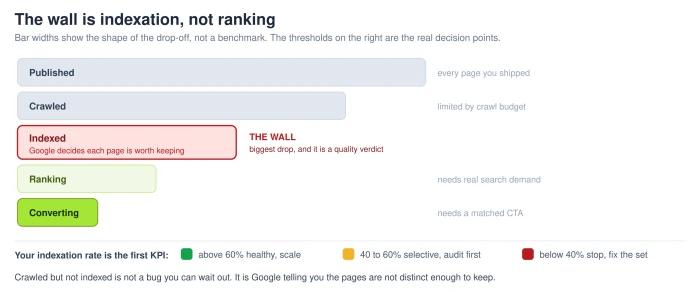
The mechanic is supply and demand. When you add thousands of programmatic pages, you increase the supply of URLs dramatically without doing anything to increase Google's demand for them, and Google's documentation is blunt that having many low-value URLs can hurt a site's crawling and indexing overall. So Google triages. It crawls what it can afford to crawl, and it indexes what it judges worth keeping.
The most useful thing I can tell you about this phase is how to read it. If your pages are being crawled but not indexed, that is not a technical bug to route around. It is Google telling you the pages are not distinct or valuable enough, and it is a verdict delivered far earlier than any traffic report. One practitioner reported publishing 150 programmatic pages and getting 15 indexed, then discovering that padding the near-duplicates with thousands of extra words changed nothing. The content had to be substantively different, page by page, before Google would take it.
So make indexation rate your first KPI, and hold it to real thresholds.
| Indexation rate | What it means | What to do |
|---|---|---|
| Above 60% | Healthy. Google finds the pages worth keeping | Scale the pattern in batches |
| 40% to 60% | Google is being selective, which points at quality concerns | Pause scaling and audit before adding more |
| Below 40% | Google is actively rejecting most of the set | Stop. Fix uniqueness and value, or kill the pattern |
One reassurance to balance that: 100 percent indexation is not achievable for any large site, and chasing it is a waste of energy. Some pages will always sit in the "discovered, currently not indexed" bucket. The goal is a healthy majority, not perfection.
Crawl budget is the time and resources Google is willing to devote to crawling your site, and it is set by two things: how hard Googlebot is willing to work on your server, and how interesting Google finds your content. Google's own large-site guidance says this only really becomes a concern above roughly a million pages, or above ten thousand pages that change very frequently, and that if your pages are typically crawled the day you publish them, you can safely ignore the topic.
Programmatic SEO is precisely the case that breaks that comfort. You are not adding pages gradually, you are multiplying your URL count overnight, and the allocation Google decided for your site was not sized for that. This produces the counterintuitive rule that governs your timeline: publishing everything at once is slower than publishing in batches. Dump 5,000 URLs on day one and most sit uncrawled while your crawl budget is spread thin across pages of unproven value. Ship 100 good ones, let them get indexed and earn impressions, and you have given Google evidence that pages from this pattern are worth crawling, which makes the next 500 go faster.
The technical hygiene that protects the budget is well established and worth doing before you launch rather than after:
"It depends" is a true but cowardly answer. Here is what it actually depends on, so you can place yourself on the range rather than hoping for the good end of it.
| Variable | Faster end | Slower end |
|---|---|---|
| Domain authority | Established domain, crawl history, existing rankings | New domain starting from zero, commonly 3 to 6 months slower |
| Template quality | Real structure and value per page, page-specific depth | One body text with a swapped H1 and title tag |
| Content uniqueness | Proprietary data, real examples, page-specific proof | Rearranged competitor facts, AI filler at volume |
| Internal linking | Pillar plus cluster, everything within 3 clicks | Flat pile of orphaned URLs, no hub |
| Crawl budget and site health | Fast, server-rendered, segmented sitemaps, clean robots | Slow, JS-rendered, one giant sitemap, crawl traps |
| Demand and competition | Validated long-tail with real volume, low difficulty | Head terms, or modifiers with no search volume at all |
Score yourself honestly. If you land on the slower end of four or more of these, do not double your timeline expectation and wait. Fix the variables first, because most of them are fixable before launch and almost none of them are fixable by patience. The last row deserves special attention: pages targeting modifiers nobody searches cannot rank for anything, ever. They get indexed, sit at position 60 forever, and eat the crawl budget your good pages needed. Validate every modifier variation for real volume before you build, and if more than about 40 percent of your modifier pool has zero volume, the pattern is not ready. The keyword clustering guide covers how to do that validation at scale.
The practical payoff of knowing the phases is that you can diagnose the project months before the traffic chart would tell you anything. At each checkpoint there is a healthy signal and a trouble signal, and the trouble signals each have a specific diagnosis rather than the generic prescription of waiting longer.
| Checkpoint | Healthy | Trouble, and what it means |
|---|---|---|
| Week 4 | Pilot pages starting to index | Near-zero indexed: uniqueness or technical problem, not time |
| Week 8 | Impressions climbing on indexed pages | Indexed but zero impressions: no demand for those modifiers |
| Month 3 | Average position improving, first clicks | Impressions flat at position 60: intent mismatch or too competitive |
| Month 6 | Clicks converting to trials or leads | Clicks but no conversions: a ranking page, not a converting page |
That last row is its own discipline, and it is the one teams discover too late. A page can clear all four phases, rank beautifully, and still sell nothing, because ranking and converting are different jobs. We cover how to build pages that do both in the guide to programmatic SEO for SaaS.
There are two opposite ways to get this wrong, and both are common.
The first is quitting too early. The most frequent failure mode in programmatic SEO is abandoning the project at six weeks because the numbers are not there yet, when six weeks is barely the end of phase one and the numbers were never going to be there yet. If your pages are indexing and impressions are appearing, the machine is working and you are simply early.
The second is the mirror image, and it is less discussed: waiting at month five for a phase that cannot arrive. If indexation was 15 percent at week six and you did nothing about it, month five will not be kinder. You are not being patient, you are being passive about a verdict Google already delivered. The discipline is to separate those two situations by diagnosis, not by mood. Indexing well and early is a reason to wait. Rejected at the wall is a reason to fix or kill, and the sooner you accept that, the less budget you burn scaling a pattern that was never going to work.
The counterintuitive truth of programmatic timelines is that the careful route is the fast route, because it stops you scaling a pattern Google was never going to index.
Ninety days gets you a validated pattern and a set that is indexing, not a revenue line. Revenue is phase four, and phase four starts around month six. Building the operational muscle to run this repeatedly is a separate problem, covered in the guide to scaling content without losing control.
The outlier case studies are real, and they are worth understanding for what they actually teach rather than as a forecast. One design tool reported growing organic traffic roughly 220 percent in a single quarter off programmatic mockup pages, moving from around 5,500 to 17,700 monthly visitors, with signups climbing from 67 to 2,100 a month. A real-estate company expanded from 10,000 to 425,000 pages in three months and reported traffic growth in the thousands of percent. A telecom tool found that programmatic area-code pages came to drive the large majority of its US traffic.
The pattern in every fast case is the same: existing domain authority, genuinely differentiated data the competition could not replicate, and real long-tail demand in a niche nobody had bothered to serve properly. The pattern in the slow cases is also the same: a new domain, a generic template, and competitive terms. The outliers are the ceiling, not the average, and quoting them at your leadership team as a forecast is how you end up defending a project at month four. Zapier is the honest reference point here, because its programmatic engine took years, not quarters, to reach the scale everyone cites it for.
The realistic promise is this: on a decent domain, with a template that earns its indexation, you will know within six weeks whether the pattern works, have rankings worth watching by month three to six, and revenue that compounds from month six onward. That is slower than the case studies and considerably more likely to happen to you.
On a domain with existing authority and a well-differentiated template, expect first pages to index within two to four weeks, first impressions by weeks four to eight, rankings that matter between months three and six, and meaningful leads between months six and twelve. On a new domain with a generic template it takes considerably longer, and often never arrives, because the pages are not indexed in the first place.
The first pages of a small batch typically appear within two to four weeks, but indexation is partial rather than all-or-nothing, and large batches take far longer. Google has to discover, crawl, and then decide each page is worth keeping. Publishing thousands of URLs at once increases supply without increasing Google's crawl demand, so most of them sit in the queue.
Almost always because Google has decided they are not distinct enough to keep. Crawled but not indexed is a quality verdict, not a technical bug, and adding more words to near-duplicate pages does not fix it. The other common causes are crawl budget exhaustion from publishing too much at once, bloated or missing sitemaps, and pages targeting modifiers with no real search demand.
Above 60 percent is healthy and a signal to scale. Between 40 and 60 percent means Google is being selective and points at quality concerns, so audit before scaling. Below 40 percent means Google is actively rejecting most of your set, and scaling will make it worse. One hundred percent indexation is not a realistic target for any large site.
Substantially. An established domain with crawl history and existing rankings has a foundation Google already trusts, so new pages get crawled and evaluated faster. A new domain starts from zero, and the gap commonly means three to six months of difference. On weak domains, large batches of programmatic pages are frequently crawled but never indexed at all.
Start with 50 to 100, confirm they index and convert, then scale in batches. Publishing the whole set on day one is slower, not faster, because dumping thousands of URLs on a site with limited crawl budget usually means most are never indexed. Controlled batches prove the pattern before you commit to it.
Not at six weeks, which is the most common failure mode, but do stop scaling once the diagnosis is clear. Indexation below 40 percent at six weeks is a quality problem, not a time problem. Indexed pages with zero impressions at three months means the modifiers have no demand. Fix the diagnosed problem or kill the pattern rather than waiting for a phase that cannot arrive.
Keep Reading

A checksum error means data failed its integrity check. Which one you...

A buyer's guide to answer engine optimization services in 2026: what A...

An honest three-way comparison of Frase, Surfer SEO, and Writimate acr...

A conversion-focused guide to programmatic SEO for SaaS: the page type...

An honest 2026 Surfer SEO review: Content Editor, Surfer AI, pricing,...

A clear, honest definition of AI SEO agents and how they differ from A...