What Is a Checksum Error? 7 Causes and How to Fix Each
A checksum error means data failed its integrity check. Which one you...
An honest three-way comparison of Frase, Surfer SEO, and Writimate across pipeline depth, automation, research, optimization, publishing, monitoring, and scalability, including 2026 pricing and where each one loses.


Disclosure, before anything else
Writimate is our tool. You are about to read a three-way comparison published by one of the three, which is exactly the setup that should make you suspicious. It should make you suspicious of the competition too: the two highest-ranking comparisons for this query are Frase's own page, which concludes Frase wins, and Surfer's own page, which concludes Surfer wins.
So here is the deal we will hold ourselves to. Frase and Surfer each get their real, documented wins, including the ones that beat us outright. We will name the columns where Writimate simply loses, and there is more than one. If you do not find that below, close the tab and trust nothing else on this site.
Now the useful part, which is that almost every comparison of these tools is answering a question that stopped being relevant about a year ago.
Open any Frase versus Surfer article and you will find the same framing: Frase started as a content creation tool and bolted on SEO, Surfer started as an optimizer and bolted on writing, so pick based on whether you would rather write or optimize. That was a perfectly good analysis in 2024. It is now obsolete, because one of the two tools moved and the other did not.
Frase moved. It repositioned around what it calls agentic SEO and GEO, and shipped an agent with something in the region of 80 skills that runs multi-step tasks from a single instruction, plus AI visibility tracking, site audits, direct CMS publishing, and a feature called Content Guard that scans on a schedule, catches pages slipping in the rankings, drafts the fix, and republishes it once you approve. That is not a writing tool with SEO features. That is an attempt at the entire loop.
Surfer did not move, and that was arguably the correct decision. It doubled down on being the best on-page optimizer in existence, added AI-search fact coverage inside the editor, and left the rest of the pipeline to you and your other subscriptions.
Which means the real 2026 question is not "which writes better." It is a three-way fork: do you want one stage done superbly, the whole pipeline done adequately, or the whole pipeline done your way? That is the comparison this article actually runs, using the seven stages any content operation has to cover.
| Tool | What it actually is | The bet you are making |
|---|---|---|
| Surfer | A best-in-class point optimizer with a validated score | Optimization quality matters more than coverage |
| Frase | An agentic pipeline covering research through monitoring | Coverage and automation matter more than any single stage |
| Writimate | A pipeline you own, running on your own API keys | Control and cost structure matter more than convenience |
Those are genuinely different products that happen to share a search results page. Anyone telling you one of them is simply "better" is either selling it or has not looked closely.
Here is the whole comparison in one picture, scored across the stages that matter: research, briefs, drafting, optimization, publishing, monitoring, and scale.

Read that matrix honestly and three findings fall out, one of which is uncomfortable for us.
Surfer wins one column and does not compete in most of the others. Its optimization is the best available, and it is the only tool here with published evidence for that claim. Everything else is partial, an add-on, or absent. That is not a criticism, it is the product's stated scope, and we said as much in our Surfer SEO review.
Frase covers every stage and wins one outright. Its monitoring is the best in this comparison by a distance, and it is the only tool that closes the loop from detecting decay to republishing a fix. But look at its optimization column: adequate, not excellent, and there is real data behind that verdict, which we get to below.
Writimate has no monitoring at all. That is the honest gap. Our pipeline runs keyword research through to publishing, and then it stops. If you want to know that a page slipped from position 4 to position 11 last Tuesday, Writimate will not tell you, and Frase will. That is a real reason to buy Frase instead of us, and we would rather say it than have you discover it in month two.
All three claim automation. They mean three different things by it, and the difference is worth understanding before you pay for any of them.
Surfer automates within a task. Surfy, its in-editor assistant, is included in your plan and responds to slash commands: rewrite this, expand that, adjust the tone. It is genuinely useful and it is not an agent. Multi-step work, auditing the site, prioritizing what to fix, briefing a batch, is still coordination you do by hand. Surfer's own framing does not really dispute this.
Frase automates across tasks. Its agent takes an instruction like "analyze the top competitors for this topic, find the gaps, and build me an outline on brand" and executes the chain. Roughly 80 skills across 17 categories, included on every plan including the entry tier, which is notable because most vendors would have made that the upsell. This is the most genuinely agentic product of the three, and if you want the framework for judging that claim, our piece on what an AI SEO agent actually is lays out the four-capability test it passes.
Writimate automates as workflows you own. The pipeline runs as a chain of n8n workflows against your own API keys: keyword research pulls from Ahrefs, a SERP and competitor-gap pass identifies what the ranking pages cover, article generation runs section by section rather than in one shot (which is the unglamorous reason it reliably hits long-form targets instead of trailing off at 900 words), then schema, internal-link suggestions, and export. The research context persists across the chain, so what the research step learned is sitting there when you write.
The honest distinction: Frase's agent is more capable and requires nothing from you. Writimate's workflows are more malleable and require everything from you. Pick your poison.
Research is where these tools quietly diverge, because it comes down to whose data you are looking at.
Frase's origin story is research, and it shows: fast SERP analysis, briefs generated in about ninety seconds, People Also Ask extraction, competitor patterns pulled into a usable outline. It is the fastest keyword-to-brief workflow of the three, and reviewers consistently rate this as its strongest genuine value.
Surfer's SERP Analyzer is deeper, breaking down the top 50 results across hundreds of on-page factors with correlation indicators, which is glorious if you are the kind of person who enjoys that and overkill if you are not. The catch is twofold: it is a $29 monthly add-on on lower plans, and Surfer's own keyword research is the acknowledged weak spot in its suite. Most serious Surfer users pair it with Ahrefs or Semrush anyway.
Writimate pulls keyword data directly from the Ahrefs API, which means you are looking at Ahrefs data rather than a vendor's interpretation of it, and you pay Ahrefs for it. Whether that is an advantage depends entirely on whether you already have that subscription. If you do, you are not paying twice for a worse copy of data you already own. If you do not, that is a real cost the other two absorb into their pricing.
Every other axis in this comparison is judgment. This one has numbers, and they do not favor us or Frase.
Surfer cites an Originality.ai study putting its Content Score's correlation with Google rankings at 26 percent, and its own 2025 study across a million SERP entries at a 0.28 Spearman correlation. It also cites an Ahrefs analysis putting Frase's score correlation at roughly 0.1. Those numbers come from Surfer, which is Frase's direct competitor, so apply the appropriate discount. But the salient fact is that Frase has not published benchmarks of its own, and Surfer has published several. In a category built on trust-me scores, being the only one showing your working is worth something.
So the verdict on optimization is genuinely uncomfortable if you are rooting for the underdog: Surfer wins, on evidence, not vibes. If your content lives or dies on competitive SERPs where on-page execution is the deciding margin, that validated score is the single best reason to pay Surfer's premium.
Two caveats keep it honest. Surfer's score is gamified and chasing it produces bloated, mechanical writing, which we covered at length in the review. And Frase's editor does something Surfer's does not: dual SEO and GEO scoring side by side with an E-E-A-T breakdown, which is a genuinely different bet about where search is heading rather than a worse version of the same bet. Writimate does not compete here at all: it handles schema and internal links, not a real-time optimization score, and pretending otherwise would be exactly the kind of claim this article exists to avoid.
The least glamorous stage and the one that quietly eats your week at volume.
Frase publishes directly to supported CMS platforms including WordPress, and because publishing is inside the agent's remit, it can be the last step of an automated chain rather than a separate chore. Surfer exports: you can edit meta title and description inside the tool with live character counts, push to WordPress, or copy out clean HTML or markdown, and the Google Docs integration means writers can stay where they are comfortable. Functional, but it is an export, not a pipeline step. Writimate pushes through the WordPress REST API as the terminal step of the workflow chain, which is the same shape as Frase's approach with the same tradeoff as everything else here: ours bends to your process, theirs already works.
Nobody is dramatically better here. It is the one stage that is close to a tie.
This is where the 2026 comparison is genuinely decided, and where Frase has built its clearest lead.
Content Guard runs scheduled scans, identifies pages losing rankings, drafts the fix, and republishes on approval. That closes the loop: measurement leads to a published correction rather than a report you file and forget. Nothing else in this comparison does that. Alongside it, Frase tracks AI visibility across ChatGPT, Perplexity, Gemini, Claude, and Google's AI surfaces, and in 2026 it folded that tracking into every plan after previously charging around $35 a month for it.
Surfer charges roughly $95 a month for a comparable AI Visibility Tracker on top of your base subscription, and independent testing has raised questions about the accuracy of its snapshot method. It does have rank-drop detection and a cannibalization report, but those sit on the $182 Pro plan and above. Its Audit tool connects to Search Console and flags under-optimized pages, which is useful but is a manual diagnosis rather than an automated loop.
Writimate does not do monitoring. Not partially, not on a higher tier. It is not in the pipeline. If continuous decay detection and AI-visibility tracking are on your must-have list, this comparison ends here and the answer is Frase.
Sticker prices are misleading in this category, because all three scale on completely different axes: Frase on volume and seats, Surfer on documents plus add-ons plus per-article credits, Writimate on API usage.
| Tool | Entry | Working tier | Trial | What the sticker hides |
|---|---|---|---|---|
| Frase | $39/mo Starter (annual) | $103/mo Professional; $239/mo Scale (annual), the agency tier with multiple client domains and around 100 articles a month | 7 days free, no card | An optional add-on unlocks unlimited generation and deeper SERP data; white-label and client portal are Enterprise only |
| Surfer | $49/mo Discovery | $99/mo Standard; $182/mo Pro; $299/mo Peace of Mind; $999/mo Enterprise | None, 7-day money back | SERP Analyzer +$29/mo, AI Visibility Tracker around +$95/mo, full AI articles from about $15 each in credits |
| Writimate | [Vinod: insert Writimate's actual pricing tiers and trial terms here.] | You supply and pay for the Ahrefs and model API keys directly, so cost tracks real usage rather than seats or credits | ||
The comparison people miss: a Surfer Standard user who also wants the SERP Analyzer and the AI tracker is not paying $99, they are paying north of $220, and every full AI article is another $15 on top. Frase at $103 includes the agent, the GEO tracking, and Content Guard with no add-on maths. On raw price-to-coverage, Frase is the better value and it is not particularly close, which is a strange sentence to publish on a competitor's blog and is nevertheless true.
Where the owned-pipeline model changes the arithmetic is at genuine volume, because credits and document caps scale linearly with output while API usage scales with actual tokens and calls. If you publish four articles a month, this is irrelevant and you should buy something. If you publish forty, it starts to matter, which is a calculation we walk through properly in the agency versus automation cost breakdown.
Strip away the feature grids and this comparison collapses into one architectural decision.
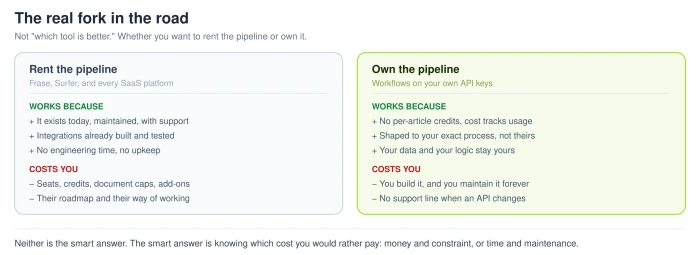
Renting is the right answer for most teams, and anyone who tells you otherwise is selling a build. A platform exists today, it is maintained by people whose job that is, the integrations are already tested, and when something breaks there is a support queue rather than your evening. You pay for that in seats, credits, caps, and living inside someone else's idea of how content should be made.
Owning is the right answer when the constraints start costing more than the convenience is worth: when per-article credits have become a tax on your growth, when your process is genuinely unusual, or when you want the data and the logic to stay yours. You pay for that in build time and permanent maintenance, and when an API changes on a Friday, that is your problem now. Our honest read is that the crossover point sits somewhere around real publishing volume plus a team with the appetite to maintain things, which is a smaller group than the people who think they want it.
The honest scoreboard, from the company that would benefit most from lying about it.
Frase wins the pipeline. Broadest coverage, the only real monitoring loop, GEO tracking included rather than upsold, the most capable agent, and the best value at every tier. If you are choosing on coverage and price, it is the answer, and the fact that we sell a competing product does not change the matrix.
Surfer wins the craft. One stage, done better than anyone, with published evidence rather than a marketing claim. If your business turns on winning hard SERPs, the premium is defensible and the rest of the pipeline is a problem you solve elsewhere.
Writimate wins on ownership, and loses on maturity. No credits, no caps, no vendor roadmap, and a pipeline shaped to your process rather than ours. Also: no monitoring, no validated optimization score, and you maintain it. That is a genuinely good trade for some operations and a bad one for most, and we would rather you self-select honestly than churn in month three.
The meta-point, which survives whichever you pick: all three automate the same layer, the repeatable operational grind of research, briefs, structural drafts, and publishing. None of them supplies the expertise, the accuracy, or the point of view that actually makes content rank in 2026, and publishing any of their raw output at volume is precisely what the current spam policies were built to demote. Automate the repeatable. Keep the judgment human. That principle costs nothing and outlasts every tool on this page.
Surfer is a point optimizer: it grades a single page against the top-ranking results and gives you a validated score, and it does that better than anyone. Frase is a pipeline: research, briefs, drafting, publishing, and monitoring in one agentic workflow, without winning any single stage outright. Surfer optimizes one page brilliantly. Frase runs the whole loop adequately.
Frase, for most teams. Its agent runs multi-step workflows from one instruction across roughly 80 skills and is included on every plan, and its drafting is more developed than Surfer AI, which charges credits per article. Both still produce drafts that need real human editing, and Frase's output is commonly described as stiff and formal.
Frase, at both the entry and the realistic working tier. It starts at $39 a month billed annually with AI visibility tracking included on every plan. Surfer starts at $49 but the real cost climbs with add-ons: roughly $29 for the SERP Analyzer, around $95 for the AI Visibility Tracker, and about $15 per full AI article in credits. Frase also has a 7-day free trial; Surfer offers only a money-back guarantee.
Surfer, and it is the one axis here with measurable evidence. Surfer cites an Originality.ai study at 26 percent correlation with rankings and its own million-entry 2025 study at 0.28 Spearman, alongside an Ahrefs analysis putting Frase's score near 0.1. Those figures come from Surfer, a competitor, so weigh them accordingly, but Frase has published no counter-benchmarks.
Buy if you want it working today with support and no maintenance, and can live with seats, credits, and the vendor's way of working. Build if you want the pipeline shaped to your process with cost tracking usage rather than credits, and you will maintain it when an API changes. The question is which cost you would rather pay: money and constraint, or time and upkeep.
No. All three automate the repeatable operational layer: research, briefs, structural drafts, on-page mechanics, publishing, monitoring. None supplies strategy, genuine expertise, accuracy, or brand voice, and publishing raw output at volume is what Google's 2026 spam policies target. The pipeline removes busywork so a human can do the part that actually ranks.
Frase, decisively, on capability and price. It tracks AI visibility across ChatGPT, Perplexity, Gemini, Claude, and Google's AI surfaces, included on all plans since 2026 after previously being an add-on. Surfer charges around $95 a month for a comparable tracker, and its editor-level AI Search fact coverage is good but a different feature. Writimate does not offer AI visibility tracking at all.
Disclosure: Writimate is our own product and appears in this comparison, clearly labeled throughout. Frase and Surfer pricing and features are accurate as of 2026 and change frequently, so verify current plans on each vendor's site before buying. Correlation figures attributed to Surfer are that company's published claims about itself and a competitor, and are presented as such.
Keep Reading

A checksum error means data failed its integrity check. Which one you...

A buyer's guide to answer engine optimization services in 2026: what A...

Realistic programmatic SEO timelines: indexation in weeks 0 to 4, firs...

A conversion-focused guide to programmatic SEO for SaaS: the page type...

An honest 2026 Surfer SEO review: Content Editor, Surfer AI, pricing,...

A clear, honest definition of AI SEO agents and how they differ from A...