
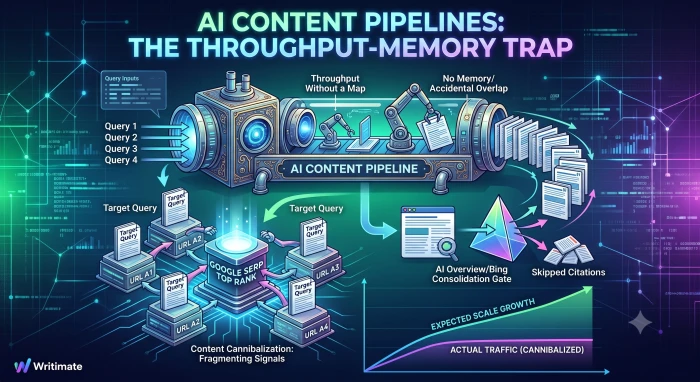
You built an AI content pipeline to publish faster. Now you're publishing so much that your own pages are fighting each other in Google, and traffic that should be climbing has flatlined instead.
This is content cannibalization, and AI pipelines are unusually good at causing it. If you're setting one up from scratch, the full workflow from keyword to published article is worth reading first — this piece covers the specific failure mode that pipeline introduces. A human writing one article a week rarely forgets what they published last month. A pipeline generating thirty articles a week has no memory at all unless you build one in. The result is a slow, quiet erosion: two, three, or four pages targeting the same query, none of them ranking as well as a single strong page would have.
What Cannibalization Actually Is (And What It Isn't)
Keyword cannibalization happens when multiple pages on your site target the same keyword and the same search intent, so they compete against each other instead of consolidating strength into one URL. Because Google generally shows only one page per domain for a given query, your pages end up splitting the ranking signals — backlinks, internal link equity, and engagement data — across several URLs rather than concentrating them on one.
The critical word is intent, not keyword. Two pages can share a keyword without cannibalizing if they serve genuinely different intent. A page for "hotels in Paris" and a page for a specific Paris hotel fulfill distinct needs and coexist fine. Conversely, two pages with zero shared keywords can still cannibalize each other if they answer the same underlying question. A page targeting "best CRM software" and one targeting "top CRM tools" use different words but serve identical intent — and when Google sees the same intent served twice, it picks one and the other loses out.
That distinction matters more with AI, because language models are fluent at rephrasing. A pipeline can produce ten articles with different titles and different sentences that all secretly answer the same question. Surface-level word matching won't catch it. Intent overlap will.
It's also worth being honest about when overlap is not a problem. Not every case of two ranking URLs is harmful. The issue becomes real and worth fixing when both pages are stuck on page two or three with neither breaking through, when rankings visibly rotate between the two URLs, or when a low-converting blog post is outranking the page you actually want to rank. If two pages each pull strong, non-overlapping traffic, leave them alone.
Why AI Pipelines Cannibalize More Than Human Teams
Traditional cannibalization is a byproduct of slow site growth — over years, writers independently pick overlapping keywords and nobody notices. AI pipelines compress that same failure into weeks. A few specific mechanisms are at play.
Volume without memory is the first. The whole point of a pipeline is throughput, but throughput without a keyword map means the system re-derives similar topics from similar inputs and produces near-duplicate angles. Feed a clustering step the same seed keyword twice and you'll often get two overlapping briefs.
Semantic drift is the second. When you prompt a model to "write about email deliverability," and later prompt it to "write about avoiding the spam folder," a human sees two topics. The model may produce two articles covering 70% of the same ground, because the underlying intent is nearly identical even though the phrasing differs.
The third, and increasingly the costliest, is what happens in AI search. Bing stated in a December 2025 webmaster post that AI systems cluster near-duplicate pages and select just one to represent the set — and that representative page may be outdated. So cannibalization in 2026 isn't only a position drop in classic search results; it can mean a skipped citation in AI Overviews and ChatGPT-style answers. There's a related wrinkle here: AI engines tend to draw citation-worthy material from roughly the first third of a page. When two of your pages have nearly identical opening sections, you're handing the model the same intro twice and asking it to choose one.
This connects directly to Google's helpful content guidance. That documentation never uses the word "cannibalization," but it asks whether content provides substantial additional value and originality. If three of your pages overlap heavily, the answer for at least two of them is no — which is closer to the real reason Google penalizes some AI content than the myth that it penalizes AI content as such. Duplicate pages also fragment the authorship, references, and engagement signals that build trust and E-E-A-T, spreading them thin across URLs instead of concentrating them.
Where the Damage Shows Up
When cannibalization takes hold, the symptoms are recognizable. Two of your URLs appear for the same query in Search Console's Pages view, and their positions swap back and forth week to week. Backlinks that should reinforce one authoritative page arrive inconsistently across several weaker ones, so no single page accumulates real authority. And on commercial terms, a stray old blog post outranks your money page, capturing the traffic but converting none of it.
The traffic math is unforgiving. When two pages both rank in the top ten, the lower one typically captures only a small slice of additional traffic — an Ahrefs study cited across the industry puts it in the 2 to 10% range, not 50%. So the sum of two half-strength pages is almost always less than one full-strength page. Consolidation trades a small loss for a much bigger gain.
Build Prevention Into the Pipeline, Not the Cleanup
Fixing cannibalization after the fact is expensive. The far better move is to make it structurally hard for your pipeline to create the problem. Six controls do most of the work.
1. A keyword map that every article must pass through
This is the single most important control, and it's almost embarrassingly simple. Maintain one spreadsheet with three columns: primary keyword, target URL, and intent type (informational, commercial, transactional, navigational). Every new piece gets a row before it's written. If the pipeline wants to target a keyword already in the map, it needs an explicit reason — a different intent, a different audience, or a defined cluster role. Most sites don't do this, which is precisely why most sites cannibalize.
For an AI pipeline, this becomes a hard gate. Before a brief is generated, the system checks the proposed primary keyword and intent against the map. A match with no differentiating reason blocks the article. This is trivial to automate and it prevents the majority of accidental overlap. Once a topic clears the gate, the brief itself should lock in the distinct intent and required angle so the model can't drift back toward a topic you already own.
2. A pre-publish keyword and intent check
Even with a map, run a live check before anything goes out. The strongest method groups keywords by actual SERP overlap rather than text similarity: pull the top ten results for two candidate queries, and if they share roughly 70% or more of the same ranking URLs, they're the same intent and belong on one page. This SERP-overlap test catches the semantically-different-but-intent-identical cases that word matching misses entirely — exactly the trap AI phrasing sets. A quick site:yourdomain.com "target keyword" search plus the Search Console Pages view are the free, manual versions of the same check.
3. Parent-topic clustering with distinct spoke angles
Organize the pipeline's output as a hub-and-spoke structure: one pillar page covering a broad topic, supported by spokes that each answer a narrower question the pillar can't cover in depth. The discipline that keeps this from cannibalizing is a single test — if you can't articulate a distinct angle for a spoke, it's a cannibalization risk, not a cluster member. A good spoke stands alone as a complete answer to its own narrow question, and the pillar links to it as "read more on X." A bad spoke is just a summary of the pillar, and it competes with it. Intent-based clustering tools that group by SERP data rather than semantics make this reliable at scale.
4. URL mapping before generation
Assign the destination URL at brief time, not publish time. When the pipeline knows in advance that a topic maps to /email-deliverability/ and a related topic maps to /email-deliverability/spam-folder-guide/, it has a structural reason to treat them as pillar and spoke rather than two independent competing posts. Flat, un-mapped URL structures invite overlap; a planned hierarchy discourages it.
5. Deliberate internal linking
Internal links tell Google which page you consider authoritative for a term. If you don't link to your main page with consistent anchor text, the search engine has to guess, and rankings get unstable. Bake this into the pipeline: every spoke links up to its pillar, the pillar links down to its spokes, and the primary page for a keyword receives internal links using that keyword's anchor. When you need to signal priority between two pages that already overlap, add a link from the weaker page to the one you want to win, using exact-match anchor text.
6. A clear update-versus-new-post rule
Before the pipeline spins up a new article, it should ask whether an existing page already serves this intent. If one does, the correct action is usually to update and expand that page — not publish a competitor to it. A simple rule: new intent gets a new post; same intent gets an update. This single rule prevents the most common AI-pipeline failure, which is generating a fresh take on a question you already answered six weeks ago.
When Overlap Already Exists: The Consolidation Decision
If your pipeline has already produced competing pages, you have four tools, and choosing the wrong one wastes signals. The decision hinges on one question: does the duplicate page need to stay accessible, or is it gone for good?
Merge and 301 redirect is the default fix when two pages target the same keyword and intent and one clearly outperforms the other. Pull the valuable material from the weaker page into the stronger one, then 301-redirect the weaker URL to it. A 301 permanently moves users and crawlers to the new page and consolidates the ranking signals — link equity, authority — into one place. This is the right choice when the content is genuinely being replaced and the old URL has no reason to stay live. After redirecting, update internal links pointing to the old URL and remove it from your sitemap.
Canonical tag is for when both pages should stay live for users but you want only one indexed and ranked. You add rel="canonical" to the non-preferred pages pointing at the preferred one. Unlike a 301, the other URLs remain accessible; the canonical is a strong hint (not a directive) that consolidates signals to the chosen page. Use it for near-duplicate variants that serve a purpose for visitors — regional versions, parameter URLs like sort and filter pages — where a redirect would break the experience.
Noindex is for when a page should stay live but should not appear in search at all. Unlike a canonical, noindex is a directive Google obeys, dropping the page from results entirely. Reach for it when a page has a real reason to exist for users but no business ranking — and it won't contribute ranking signals to anything. Never combine noindex with a canonical on the same page; that sends mixed instructions.
Re-optimize for distinct intent is the fix when the pages shouldn't have been merged in the first place because they genuinely serve different readers. De-optimize the intruding page — remove the exact-match keyword from its title, H1, and meta description, and shift its focus to a distinct long-tail variant. This keeps both pages but stops them from competing.
A clean way to remember it: if the content is gone, choose a 301; if the content coexists, choose a canonical; if it should live but never rank, choose noindex; if it deserves its own audience, re-optimize.
The Ongoing Discipline
Cannibalization isn't a one-time cleanup. On any site that keeps publishing — and a pipeline publishes relentlessly — it creeps back. The maintenance rhythm is a structured audit every few months: run a Search Console query-and-pages review to find terms where multiple URLs earn impressions, check whether those URLs share intent, and apply the right consolidation tool. Watch specifically for rankings that rotate between two of your own URLs, which is the clearest live signal that you're competing with yourself.
The larger point is that cannibalization in an AI pipeline is a systems problem, not a writing problem. You don't fix it one article at a time; you fix the system that generates articles. A keyword map with a hard gate, a SERP-overlap pre-publish check, planned URL hierarchy, and an update-versus-new-post rule turn your pipeline from something that quietly competes with itself into something that compounds authority with every publish. These checks slot in as guardrails around the core keyword-to-published pipeline, not as a separate process. Consolidate before you scale — because scaling a cannibalization problem just gives you more of it, faster.


