What Is a Checksum Error? 7 Causes and How to Fix Each
A checksum error means data failed its integrity check. Which one you...
A real 2026 cost comparison of hiring an SEO agency versus building an AI automation workflow: retainers, writer and editor costs, tools, QA time, and ROI, plus a free calculator to run your own numbers.


Every few months someone asks me whether they should fire their SEO agency and replace it with an AI workflow. It is the wrong question, and it usually comes with the wrong expectation attached, which is that a $40 monthly tool is going to do the job of a $3,500 retainer.
So let me reframe it before we touch a single number. This is not a fight between "agency" and "robot." It is a question of which parts of SEO are repeatable operational work you are currently overpaying humans to do, and which parts are genuine strategy and expertise that you should keep paying humans to do. Automation wins the first category by a landslide. It loses the second one badly. The whole game is knowing which is which, and then pricing each honestly.
That is what this piece does. Real 2026 agency costs, real automation-stack costs, the hidden line items nobody puts in a proposal, and a calculator at the bottom so you can run your own situation instead of trusting mine.
Here is the line that keeps you out of trouble, and it is not mine, it is Google's: AI content produced at scale without expert oversight does not meet the E-E-A-T bar that search engines reward. Credible operators in 2026 run on a simple principle, human-led and AI-assisted. Not AI-instead-of-human. That distinction is the difference between an automation setup that compounds and one that gets your pages demoted.
So before we compare costs, we have to split the work. Some of it is repeatable, teachable, and boring, which is exactly what automation is for. The rest depends on judgment, taste, and knowing your market, which is exactly what it is not for.
| Automate this (repeatable) | Keep this human (judgment) |
|---|---|
| Pulling keyword metrics and SERP data | Keyword strategy and which topics to actually target |
| Scaffolding briefs and outlines | The real expertise and point of view inside the writing |
| Generating meta titles and descriptions at scale | Brand voice and editorial judgment |
| Finding internal-link opportunities | Final QA and fact-checking |
| Technical crawls and audit reports | Deciding what to fix first, and why |
| Client and performance reporting dashboards | Strategy, positioning, and prioritization |
Notice the left column is everything an agency quietly bills you junior-level hours for. That is where the money is hiding, and that is what we are about to reclaim.
Let me give you the real market numbers rather than a range so wide it is useless. Survey data from Ahrefs and Clutch this year puts the average agency retainer at roughly $3,200 to $3,500 per month, though the median most businesses actually pay sits closer to $1,500 to $2,000, because a handful of enterprise deals drag the average up. Here is how it breaks down by who you are.
| Business size | Typical monthly retainer | What it usually bundles |
|---|---|---|
| Small business | $1,500 - $5,000 | Keyword research, on-page, a few articles, reporting |
| Mid-market | $5,000 - $10,000 | The above plus content production, link building, technical |
| Enterprise | $10,000 - $50,000+ | Full-stack strategy, heavy content and links, multi-stakeholder |
| US average retainer | ~$3,200 - $3,500 | The typical blended figure across the market |
The in-house route is not the cheap alternative people assume, either. A single in-house SEO specialist runs $102,000 to $168,000 a year once you add salary, benefits, and tools, and a full team of strategist, writer, technical lead, and link builder can hit $250,000 to $500,000 or more. For most businesses under a few million in revenue, that math never works, which is exactly why the agency retainer exists.
One more thing worth knowing before you sign anything: 56 percent of agencies raised their prices this year, and most retainers still do not include AI-search visibility work, even though a growing share of searches now resolve inside an AI answer. You are often paying more for a scope that covers less of where traffic actually goes.
Now the other column. An automation setup is not one tool, it is a small stack doing the repeatable jobs, plus the human time you keep for the parts that matter. The stack is cheap. The honesty is in not pretending the human time disappears.
| Layer | Example tools | Typical monthly cost |
|---|---|---|
| Workflow / AI agents | n8n, Gumloop, Make | $24 - $150 |
| Keyword and SERP data | Ahrefs or Semrush (often already owned) | Existing subscription or API usage |
| Writing and on-page optimization | Surfer, an LLM subscription | $20 - $99 |
| Human oversight | You, or an editor | 2 - 3 hours per article |
The tooling usually lands somewhere between $100 and $300 a month all in, which is a rounding error next to a retainer. The real cost of the automation path is that human oversight line, and here is the part that makes it work: operators who build these workflows report cutting per-article production from around eight hours down to two or three, because the automation handles the research grunt work, the brief, the formatting, and the publishing, leaving the human to do the thinking and the writing that actually needs a brain. You are not removing the human. You are removing five hours of the human's busywork. If you want the mechanics of that pipeline, our n8n SEO automation workflow guide walks through it end to end, and the Ahrefs API integration covers the data layer.
Put the two structures side by side and the reason automation is cheaper stops being abstract. It is not that automation is magic. It is that a retainer is mostly people doing repeatable production, and automation deletes that specific layer while leaving strategy and light oversight intact.
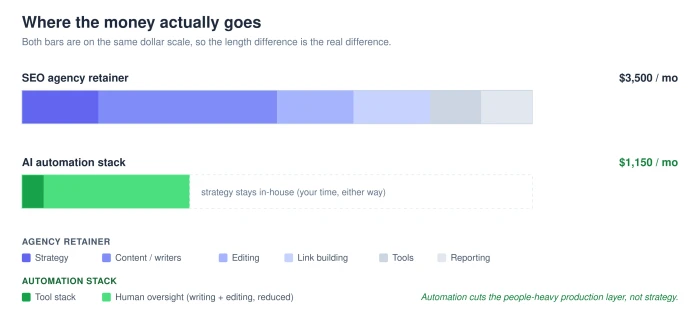
This is also why "just use AI to write everything" fails. If you delete the human layer entirely instead of just shrinking it, you are not saving money, you are manufacturing the exact thin content Google spent 2026 penalizing. The savings come from cutting the busywork, not the brain.
Averages are a starting point, not your situation. Plug in your real publishing volume and rates and see what the two paths actually cost you.
SEO Agency vs AI Automation Cost Calculator
Adjust the inputs to match your setup. Everything updates live.
This compares production economics only. An agency retainer also buys strategy, accountability, and someone to call when rankings drop. The automation column assumes you keep strategy and final QA in-house.
If you ran the calculator with honest inputs, the automation column almost certainly came out cheaper, and for most teams publishing at any real volume it is not close. But cheaper is not the same as better, so here is how to read the number without lying to yourself.
The savings are real when the work is genuinely repeatable and you actually have someone competent to do the oversight. They evaporate if you either skip the oversight (and ship slop that never ranks) or if the person doing it is learning on the job and the two hours quietly becomes six. Automation rewards teams that already know what good looks like. It punishes teams hoping the tool will supply the judgment they do not have.
The agency still wins in specific cases, and I would be lying to sell you otherwise. If you have no in-house SEO knowledge at all, an agency buys you a strategy you cannot yet produce. If you are in a brutally competitive niche where link building and digital PR decide everything, that is relationship work a workflow cannot do. And if you simply do not have the time or desire to run any of this, paying someone to own it is a legitimate purchase. The retainer is expensive because some of what it buys is genuinely hard to replace. Just make sure you are paying for that part, not for a junior pulling keyword data you could automate for $40.
Both paths have line items that never make it onto the invoice, and pretending otherwise is how people get surprised.
On the agency side: the annual contract lock-in, the ramp-up months you pay for before anything ranks, the scope creep that turns into upsells, and the quiet reality that your account might be run by someone far more junior than the person who sold you the deal.
On the automation side: the learning curve to build the workflows in the first place (real, but a one-time cost), ongoing maintenance when an API changes or a tool updates, and the single biggest hidden cost of all, the temptation to over-automate. The moment you let the machine write the parts that needed a human, you stop saving money and start accumulating a content-quality debt that a future Google update will call in. Budget for the oversight honestly, or the whole comparison is fiction.
Here is the decision, minus the diplomacy.
The point was never to replace people with robots. It was to stop paying agency rates for robot work, and to keep paying real money for the human judgment that actually moves rankings. Get that split right and the cost question answers itself. The calculator above just tells you by how much.
Ready to build the automation side instead of just pricing it? Start here:
For the repeatable production and operational work, an AI automation workflow is almost always cheaper, often by 50 to 70 percent, because you replace agency labor with a tool stack plus reduced human oversight. For strategy, genuine expertise, and accountability, an agency can still be worth its retainer. Most teams save the most by automating the operational layer and keeping strategy in-house.
Small businesses typically pay $1,500 to $5,000 per month, mid-market companies $5,000 to $10,000, and enterprises $10,000 to $50,000 or more. Survey data puts the average agency retainer around $3,200 to $3,500 per month, though the median most businesses actually pay is closer to $1,500 to $2,000.
No, and treating it that way is how sites get penalized. Automation replaces the repeatable production and operational tasks. Strategy, topic selection, genuine expertise, and final editorial judgment still need a human. Google's guidelines are explicit that AI content at scale without expert oversight fails E-E-A-T. The credible model is human-led, AI-assisted.
It depends on your publishing volume and how much oversight you keep, but for a team publishing around eight pieces a month, automating the production layer commonly cuts monthly cost from roughly $3,500 to around $1,150, a saving near 67 percent or about $28,000 a year. Use the calculator above to run your own numbers.
Keep keyword strategy and topic selection, the actual expertise and point of view in your writing, brand voice, final QA and fact-checking, and strategic prioritization human. Automate the repeatable parts around them: data pulls, SERP scraping, brief scaffolding, meta generation at scale, internal-link suggestions, reporting, and technical crawls.
Publishing raw AI content at scale is risky, because Google's spam policies target mass-produced pages with no real value regardless of how they are made. AI is safe and useful as a scaling layer on top of real expertise and data, not as a replacement for it.
Keep Reading

A checksum error means data failed its integrity check. Which one you...

A buyer's guide to answer engine optimization services in 2026: what A...

An honest three-way comparison of Frase, Surfer SEO, and Writimate acr...

Realistic programmatic SEO timelines: indexation in weeks 0 to 4, firs...

A conversion-focused guide to programmatic SEO for SaaS: the page type...

An honest 2026 Surfer SEO review: Content Editor, Surfer AI, pricing,...