What Is a Checksum Error? 7 Causes and How to Fix Each
A checksum error means data failed its integrity check. Which one you...
A clear, honest definition of AI SEO agents and how they differ from AI writers: the four things that make software an agent, what it can automate across research, briefs, drafts, audits, internal linking, publishing, and monitoring, its real limits, and

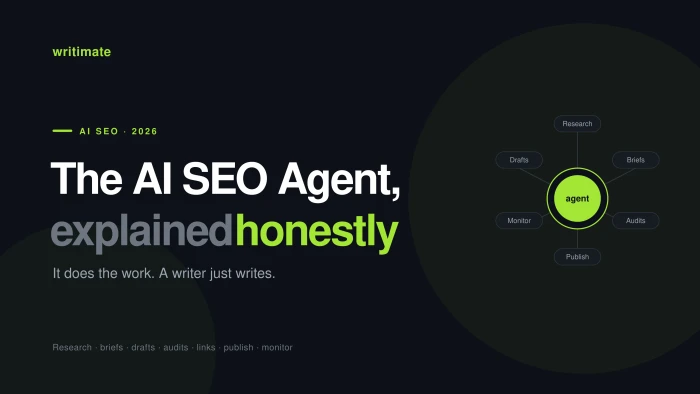
"AI SEO agent" is the most abused phrase in marketing right now, and it is abused in a specific way: a lot of the tools wearing the label are just AI writers with a keyword field and a fresh coat of paint. You type a topic, they spit out a draft, and somewhere a marketing team has decided that qualifies as "autonomous." It does not. That is a writer with good branding.
Which is a shame, because real AI SEO agents are genuinely a different category of thing, and the difference is worth understanding before you spend money on one. So this is the honest version: what an agent actually is, what separates it from the AI writer you already use, the specific work it can take off your plate, and, the part most guides conveniently skip because they are trying to sell you an agent, where it still falls on its face and needs a human.
No hype, no "fire your whole team," just a clear line between what these things really do and what they only pretend to.
Start here, because everything else follows from it. An AI writer is reactive. You give it a prompt, it gives you an output, and the loop ends until you re-engage. It is a tool you operate, and every step around the writing, deciding what to write, researching it, optimizing it, publishing it, is still yours.
An AI SEO agent is proactive and goal-oriented. You give it an outcome rather than an instruction, something like "find our fifty best long-tail opportunities, cluster them by buyer stage, and draft briefs for the top ten," and it figures out the steps and executes them. It chains multiple actions together, keeps context across them, makes decisions inside a scope you define, and runs the workflow without needing a prompt at each stage. The defining property is goal-orientation, not instruction-orientation.

| Property | AI writer | AI SEO agent |
|---|---|---|
| Trigger | Your prompt, every time | A goal you set once |
| Scope | One task (write this) | A multi-step workflow |
| Tools | None, it just writes | Uses APIs, crawlers, your CMS, analytics |
| Memory | The current chat | Context carried across steps |
| Action | Returns text to you | Executes: audits, publishes, updates |
| Who drives | You, at every step | It drives, you set direction and approve |
To make it concrete: ask an AI writer for a meta description and you get a meta description. Ask an SEO agent to fix your thin product pages and it will crawl the site, find the thin ones, analyze the competitors ranking above them, draft the improvements, and queue them for your approval. One handed you a sentence. The other did a junior specialist's afternoon.
If you want a test that cuts through the marketing, an agent is not a vibe, it is four specific capabilities working together. Miss any one and you have a fancier writer, not an agent.
That last distinction, between telling you what is wrong and actually changing it, is the cleanest line in the whole category. A tool hands you a to-do list. An agent does the to-do list. Everything marketed as an agent that only produces reports and suggestions is, by this test, still a tool.
Here is where agents earn their keep, and it is a lot of the work that currently eats your team's week. The honest framing, though, is that not every stage is equally trustworthy, so this table pairs each capability with how much rope to give it.
| Stage | What the agent does | How much to trust it |
|---|---|---|
| Research | Pulls keyword and SERP data, clusters terms, classifies intent, maps competitor gaps and entities | High. This is data work agents are genuinely good at. |
| Briefs | Turns research into a brief: target keywords, structure, word count, internal-link plan, questions to answer | High, with a human sanity check on angle and priority. |
| Drafts | Writes a structural first draft against the brief | Medium. A starting point, never the final published text. |
| Audits | Crawls the site and flags technical and on-page issues: broken links, missing tags, thin pages, schema gaps | High for detection. Review before mass-applying fixes. |
| Internal linking | Finds relevant link opportunities across your library and suggests or inserts them | Medium-high. Spot-check that the links actually make sense. |
| Publishing | Formats and pushes content to your CMS, sets metadata, submits for indexing | Only behind an approval gate. Never publish content unreviewed. |
| Monitoring | Watches rankings, traffic, technical health, and AI-visibility across answer engines, and alerts on changes | High. This is round-the-clock work no human can match. |
Two things stand out in that table. The detection and data stages, research, auditing, monitoring, are where agents are genuinely strong and where you should lean on them hard, because they are doing objective, repeatable work faster and more consistently than a person ever could. Monitoring in particular is where agents shine in 2026, because tracking your visibility not just in Google but across ChatGPT, Perplexity, Gemini, and AI Overviews is a job no human can do manually, and it matters more every month.
The generation and execution stages, drafting and publishing, are where the rope gets short, for reasons we should be blunt about.
Every vendor selling an agent has a reason to gloss over this section. We do not, so here is the honest list of what these things cannot be trusted to own, no matter how the demo looks.
Strategy. An agent can find opportunities and execute against a plan, but deciding which opportunities fit your business, what your positioning is, and what actually matters this quarter is judgment rooted in understanding your company. That is not pattern-matching, and it is the part that most determines whether any of the output is worth producing. Agents execute strategy. They do not have it.
Accuracy. Agents, being built on language models, can state things confidently that are wrong. On a factual, expertise-heavy, or regulated topic, an unchecked agent will eventually publish a mistake, and it will do so in your brand's voice on your domain. Fact-checking is a human job, and at scale it is the human job.
Genuine expertise and voice. The thing that actually makes content rank and earn trust in 2026, real experience, a distinct point of view, first-hand insight, is exactly what a model does not have. It can assemble what already exists on a topic; it cannot supply the lived expertise that Google's E-E-A-T signals reward and that readers can feel the absence of. That has to come from a person.
And the big one: unreviewed publishing at scale. The single fastest way to lose traffic is to let an agent write and publish without an editor. It produces factual errors, repetitive phrasing, and bland copy, and it produces the exact mass-generated, low-value pages that Google's 2026 spam policies were built to demote. This is not a hypothetical risk. It is the predictable outcome of removing the human from the loop, and it is why the entire safe way to run an agent is the model in the next section. We go deep on this exact line in our guides on programmatic SEO and scaling content without losing control.
The teams getting real value from agents in 2026 are not the ones handing over the keys. They are the ones who delegate the grind and keep the judgment, using a simple structure that the better platforms build in and that you should insist on.
Think of it as a split, one that some tools describe as an 85/15 model: the agent handles roughly the repeatable execution on autopilot, and flags the rest, the brand decisions, the edge cases, the high-stakes changes, for a human to sign off. You are not supervising every keystroke. You are setting boundaries and approving at the moments that matter. Three things make it work:
Run this way, an agent stops being a risk and becomes what it should be: a tireless junior team member that does the tedious work perfectly and knows when to raise its hand.
Because "agent" sells, a lot of AI writers now wear the label. Here is how to see through it before you pay, using the four-capability test from earlier as your checklist.
If a tool fails these, it might still be excellent, plenty of AI writers are worth paying for, but call it what it is and price it accordingly. You should not pay agent money for writer capabilities.
Agents are powerful, not universal. Honestly:
Use one when you have real operational volume that is eating your team, a site large enough that manual auditing and monitoring cannot keep up, or a need to track AI-search visibility that is genuinely impossible to do by hand. Agents pay off hardest at scale, where the repetitive work is crushing and a human simply cannot cover every page and every answer engine. If your bottleneck is execution capacity, an agent is the right tool.
Skip it, or wait, when you publish a handful of pieces a month and a person can comfortably handle the workflow, when you have no one to own the review and approval (an unsupervised agent is worse than no agent), or when your content lives or dies on deep expertise that a model cannot supply and you would spend more time fixing its output than writing from scratch. At small scale, an agent is overhead you do not need, and a good AI writer plus your own judgment covers you.
The deciding question is not "is the technology impressive." It is "do I have enough repeatable execution to automate, and someone to keep a hand on the wheel." If yes, an agent is a genuine unlock. If no, it is a solution shopping for a problem.
Two honest paths, the same split that runs through everything in modern SEO automation.
Buy an all-in-one agent platform and you get the workflow handled, maintained, and supported, with the integrations already built. You pay a subscription and accept the platform's way of working. This is right for most teams that want the capability without building anything, and it is the fastest way to start.
Build your own with an orchestration tool like n8n or Gumloop, plus the APIs of your keyword tool and a language model, and you get an agent shaped exactly to your process, usually at a fraction of the subscription cost, in exchange for setup time and a little technical skill. This is where the biggest efficiency gains genuinely live, and it is what we do. If that is your direction, our n8n SEO workflow guide and our roundup of the best SEO automation tools are the place to start.
Whichever path you take, start narrow. Point an agent at one job, monitoring, or auditing, or research, and compare its output to your manual process before you widen its scope. Trust is earned one workflow at a time, not handed over on day one.
Agents are one layer of a larger automated SEO operation. These go deeper on the pieces around them:
Software that autonomously carries out multi-step SEO work from a goal you set, rather than waiting for a prompt at each step. It plans a sequence of actions, uses tools like keyword APIs, crawlers, and your CMS, keeps context across steps, and takes real actions such as generating briefs, drafting, auditing, and publishing, ideally with a human approving the high-stakes moments.
An AI writer is reactive: you prompt it, it returns text, and you do everything else. An AI SEO agent is proactive and goal-oriented: you give it an outcome and it figures out and executes the steps, using tools and carrying memory across them. A writer produces text; an agent runs a workflow and acts.
Keyword and SERP research, content briefs, structural first drafts, technical and on-page audits, internal-link discovery, publishing to a CMS, and ongoing performance and AI-visibility monitoring. It should not be trusted to own strategy, guarantee accuracy, or supply real expertise and brand voice without human review.
No. It can replace much of the manual execution, data pulls, audits, reports, drafting scaffolding, which frees the specialist for strategy. It cannot replace the strategic judgment, business understanding, and editorial expertise that decide whether content ranks and survives quality updates. The realistic model is an agent on the grind and a human on the calls.
Yes, when you keep a human in the loop at the high-stakes stages, especially anything that publishes content or changes the site. The biggest risk is letting an agent write and publish unreviewed at volume, which produces errors and thin content that 2026 spam policies penalize. Set autonomy boundaries and require approval for content and technical changes.
Buy an all-in-one platform if you want it handled with support and minimal setup. Build your own with an orchestration tool like n8n plus APIs and a language model if you want an agent shaped to your process at lower cost and have some technical skill. Many teams buy the data foundation and build the custom workflows on top.
Keep Reading

A checksum error means data failed its integrity check. Which one you...

A buyer's guide to answer engine optimization services in 2026: what A...

An honest three-way comparison of Frase, Surfer SEO, and Writimate acr...

Realistic programmatic SEO timelines: indexation in weeks 0 to 4, firs...

A conversion-focused guide to programmatic SEO for SaaS: the page type...

An honest 2026 Surfer SEO review: Content Editor, Surfer AI, pricing,...