What Is a Checksum Error? 7 Causes and How to Fix Each
A checksum error means data failed its integrity check. Which one you...
A concrete content operations playbook for scaling SEO content 10x: production workflow design, a copy-paste brief template and QA checklist, where AI drafting belongs, tiered editorial review, internal linking at scale, image workflows, and publishing ca


There is a specific wall every content team hits, and it always feels the same. You can reliably produce four good articles a month. Your competitors are publishing twenty. Your strategy calls for topic clusters you will finish sometime around the next ice age. So you do the obvious thing, you try to just publish more, and within two months the quality has quietly fallen off a cliff, your one good editor is drowning, and half the new pages read like they were written by a committee of tired robots.
Here is the thing nobody tells you at that wall: the problem is not that you need to work harder or hire an army of writers. Scaling content is not a talent problem or an effort problem. It is a systems problem, and the reason your quality collapsed is not that you produced more, it is that you produced more while still using a process designed for four articles a month. The process, not the volume, is what broke.
This is the concrete version of how to fix that, with an actual brief template and an actual QA checklist you can copy, not the usual "have a template" hand-waving. If you do this right, forty a month is genuinely calmer than four a month was, because forty a month forced you to build the machine that four a month let you skip.
When you publish four articles a month, one talented person can do almost everything, and quality holds because it all runs through a single good brain. That is not a system. That is heroics, and heroics do not scale. The moment you push past what one brain can hold, the wheels come off, and they come off in a predictable place.
It is not writing. Writing capacity is rarely the true bottleneck, because writers are relatively easy to add. The bottleneck moves downstream, to review and to publishing operations. Your best editor, who could comfortably review four pieces, cannot review forty, so they either become a two-week queue that stalls everything or they start rubber-stamping, and quality dies quietly. Meanwhile the operational work nobody accounts for, formatting in the CMS, adding images, setting meta, wiring internal links, scheduling, can eat thirty minutes an article, which is a rounding error at four pieces and multiple lost days at forty.
So the fix is not "hire more writers." It is to stop relying on one person's judgment and build the judgment into the process itself, through defined stages, clear standards, and quality gates that do not depend on a single hero being available. That shift, from individual heroics to systematic checkpoints, is the whole game. Everything below is how you build it.
The single most important move is to separate an article into stages, give each stage one owner and one quality gate, and separate the creative work from the operational work so they stop interfering with each other. When a writer has to stop mid-sentence to hunt for a statistic or fight the CMS, both the writing and the formatting suffer. Pull those apart and each gets faster and better.
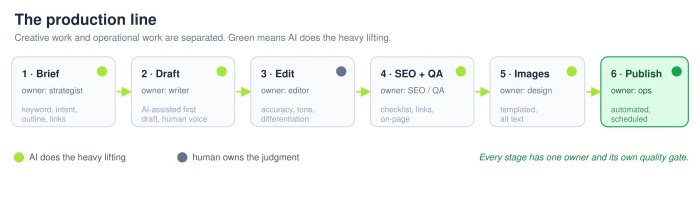
The stages are not complicated: brief, draft, edit, SEO and QA, images, publish. What matters is that each has a single accountable owner and its own definition of done, and that work flows through them in one direction. You visualize the whole thing in a shared board (Asana, Notion, Trello, whatever your team already opens), so at any moment everyone can see exactly where every piece is. The magic is not the tool. It is that "where is that article" stops being a question you have to ask a person.
Two stages carry most of the load and deserve the most attention, because they are where scaling actually lives or dies: the brief at the front, which determines whether everything downstream goes smoothly, and the review in the middle, which is where the old model chokes. We will build both properly.
A great brief is the highest-leverage document in a content operation, because a complete brief lets any competent writer produce something close to right on the first draft, which means fewer revision rounds, less editor time, and consistent output no matter who is writing. A vague brief does the opposite: it pushes all the missing decisions downstream into editing, which is exactly the stage you cannot afford to overload. Every hour you invest in the brief saves several in review.
Everyone tells you to use a brief template. Almost nobody shows you a good one. Here is the actual template, copy it.
Content brief template copy this into your brief doc
That last line is quietly one of the most useful. Keep a running list of the words and cadences that scream "a language model wrote this," and forbid them in every brief. It is the cheapest quality upgrade available, and it compounds across forty articles a month.
You cannot honestly get to forty pieces a month without AI in the mix, and you should not pretend otherwise. But the teams that use AI to scale and the teams that get penalized for it are doing two completely different things, and the difference is ruthless discipline about which parts AI touches.
Let AI carry the repeatable load: aggregating research, generating a structural first draft from a complete brief, drafting meta descriptions and title variants, suggesting internal-link targets. That is genuine time saved on the mechanical parts. What AI does not touch is the part that makes the page worth reading and safe to publish: the actual expertise, the first-hand experience, the accuracy, the brand voice, the one angle that makes it differ from everything already ranking. Conflating those two categories, letting the machine write the parts that needed a human, is precisely what causes quality to erode at scale.
| Let AI carry this | Humans own this |
|---|---|
| Research aggregation and summarizing | Accuracy and fact-checking |
| Structural first draft from the brief | Real expertise and experience |
| Meta titles and descriptions at scale | Brand voice and the differentiating angle |
| Internal-link and image-alt suggestions | Final editorial judgment |
The reassuring part, and it is worth stating plainly because it is often misunderstood, is that Google does not penalize AI involvement. It evaluates content on helpfulness and E-E-A-T, not on whether a machine helped draft it. AI-assisted work that is genuinely reviewed, fact-checked, and grounded in real expertise ranks perfectly well. What gets crushed is unreviewed AI content shipped at volume, which is a different thing entirely, and the reason the review stage below is non-negotiable. For a deeper look at where automation ends and judgment begins, our take on agency versus automation economics runs on this exact line.
This is where the old model dies, so it is where the new one has to be strongest. One editor reviewing every article in sequence simply cannot keep pace with high volume. Rush the reviews and quality drops; slow them down and you have defeated the entire point of scaling. The single-editor model is the limiting factor, full stop, regardless of how many writers you pile on behind it.
The fix is to stop treating review as one monolithic job done by one person and split it into parallel lanes with defined scope. Instead of one editor checking everything, you have specialized checkpoints: one pass for accuracy and substance, a separate pass for SEO and on-page mechanics, a light pass for voice and tone. Each reviewer stays strictly in their lane, which keeps them fast and stops the endless "well while I'm in here" rewrites that turn editing into a black hole. Build the checklists so reviewers cannot overstep, and track which stage consistently catches the most problems, because that tells you what to fix upstream in the brief or the drafting step rather than patching it forever in review.
The mindset shift is from "my best editor approves everything" to "quality is enforced by the process, and the process does not have a single point of failure." That is what lets review keep pace when output goes up tenfold.
Consistency at scale comes from a checklist that is actually enforced, ideally wired into your CMS or workflow tool so a piece cannot move to published with items unchecked, rather than a document people glance at when they remember. Here is the real one, grouped by lane so it maps to the parallel review above.
Pre-publish QA checklist nothing ships until every box is checked
Intent and substance
SEO mechanics
Accuracy and E-E-A-T
Links and images
Voice and publish
Internal linking is the task everyone lists and nobody explains, and at volume it is where a content library either becomes a connected, authority-passing structure or a heap of orphaned pages that Google never fully credits. The failure mode is treating it as a someday cleanup project. At forty articles a month, retroactive linking never happens, because there is always a fresher fire.
So link as you go, and build it into the pipeline in two places. First, the brief already lists three to five existing pages the new article should link to, so linking outward happens during drafting rather than after. Second, when a new article publishes, you add links to it from the related pages you already own, which is the step teams forget and the reason new pages sit uncrawled. Underneath both, keep a living map of your pillars and their supporting clusters, so every writer knows what connects to what without guessing. Surfacing the right link targets, both the pages a new article should link to and the existing pages that should link to it, is exactly the kind of suggestion you can automate to keep it from becoming a chore, and it pairs naturally with how you built the clusters in the first place, which we cover in the keyword clustering guide.
Images are the stage that silently sinks content velocity, because sourcing or making a custom image per article does not feel like much until you multiply it by forty and realize a designer has become your new choke point. The generic guides wave at Canva and move on. At scale you need an actual image system, and it has three parts.
The last piece is a real publishing calendar, and its job is to make output predictable rather than heroic. Without one, publishing is ad hoc, which means it is subject to whoever remembers and whoever has time, which means it is the first thing to slip. With one, everyone knows what is getting published, when, and who owns each stage of it.
It does not need to be sophisticated. A shared calendar or a simple board with a row per article and columns for stage, owner, and publish date is enough, and it beats a fancy system nobody updates. What matters is a few disciplines on top of it. Work from a backlog of briefed, ready-to-go pieces rather than starting each one from zero, so a sick day does not stall the week. Batch similar stages, a block of briefs, a block of edits, because context-switching is a hidden tax at volume. And build in a buffer, because a calendar with zero slack is a calendar that breaks the first time anything goes wrong, and at forty articles a month, something always goes wrong. The calendar is not bureaucracy. It is the thing that lets you promise a number and hit it.
Put it together and the machine is simple to describe, which is the point. A strategist briefs from clustered keywords. Writers draft from complete briefs with AI carrying the mechanical load. Parallel reviewers check accuracy, SEO, and voice in their own lanes against an enforced checklist. Images come from templates. Publishing runs on a calendar and is mostly automated. Every stage has one owner and one quality gate, and no stage depends on a single hero being available.
That is why forty a month ends up calmer than four a month felt. Four a month ran on one person holding everything in their head and hoping they had time. Forty a month runs on a system that keeps working when any one person is out, and that produces consistent quality not because everyone is brilliant every day, but because the process does not let bad work through. Volume was never the enemy. The lack of a system was. Build the system, and the volume takes care of itself.
Scaling content is one part of a larger automated SEO operation. These go deeper on the pieces that feed it:
Scale your systems before your output. Break production into staged tasks with one owner and a quality gate each, use a detailed brief template so writers get it right on the first draft, apply an enforceable QA checklist, and replace the single-editor model with parallel review. Volume without those systems produces the thin content Google penalizes.
Yes, when the content is good. Widely cited research finds companies publishing 16 or more posts a month earn several times more organic traffic than those publishing four or fewer, because a larger, high-quality library covers more topics and compounds. But volume only helps if quality holds, since Google's 2026 spam policies target mass-produced, low-value pages.
It is safe when AI is a scaling layer under human oversight, not a replacement for it. Google evaluates content on helpfulness and E-E-A-T, not on whether AI was involved, so genuinely reviewed and fact-checked AI-assisted work ranks fine. Publishing unreviewed AI content at scale is what gets penalized.
The working title, primary and secondary keywords, search intent, target reader, a word-count range based on the top-ranking pages, the differentiating angle, an outline with a note under each heading, the questions it must answer, the internal links to include, the CTA, two or three reference posts for tone, and the assets needed.
Link as you go rather than retroactively. List three to five internal links inside each brief before writing, add links to every new article from related existing pages when it publishes, and keep a living map of your pillars and clusters. Automating the link-suggestion step keeps it from becoming the bottleneck.
With a staged production line, brief templates, AI-assisted drafting, and tiered review, a lean team can commonly reach three to five times its previous output without adding headcount, so a team stuck at four a month can often reach fifteen to forty. The limiting factor is almost never writing capacity; it is review and publishing operations, which the system is built to unblock.
Keep Reading

A checksum error means data failed its integrity check. Which one you...

A buyer's guide to answer engine optimization services in 2026: what A...

An honest three-way comparison of Frase, Surfer SEO, and Writimate acr...

Realistic programmatic SEO timelines: indexation in weeks 0 to 4, firs...

A conversion-focused guide to programmatic SEO for SaaS: the page type...

An honest 2026 Surfer SEO review: Content Editor, Surfer AI, pricing,...