What Is a Checksum Error? 7 Causes and How to Fix Each
A checksum error means data failed its integrity check. Which one you...
How SaaS and content teams build programmatic SEO pages that scale and survive Google's 2026 spam updates: templates, data sources, keyword modifiers, location and use-case pages, internal linking, and quality control.


In March 2026, Google ran a core update that people are still talking about in the tone usually reserved for natural disasters. Whole sites lost most of their organic traffic in about two weeks. The common thread in the wreckage was not AI, exactly, and it was not automation, exactly. It was pages. Thousands and thousands of pages, generated from a template, that existed for Google's benefit and nobody else's.
Here is the uncomfortable part for anyone about to Google "programmatic SEO tutorial": those dead sites and the wildly successful programmatic sites (your Zapiers, your Wises, your G2s) used the exact same technique. Same spreadsheets. Same templates. Same idea. The difference between "growth engine" and "cautionary tale" was never the method. It was the architecture underneath it and whether each page had a reason to exist.
So this is not a hype piece. I have watched programmatic SEO make businesses and quietly sink them, and I am going to walk you through how it actually works: the templates, the data, the keyword modifiers, the location and use-case pages, the internal linking, and the quality control that keeps you on the right side of the next update. If you came for "publish 10,000 pages this weekend," you will be disappointed. If you came to build something that survives, keep reading.
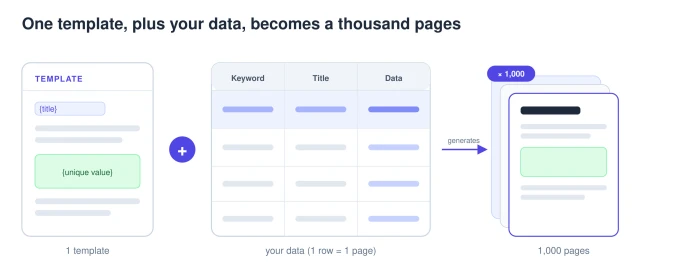
Let me define it plainly, because most explanations make it sound more exotic than it is. Programmatic SEO is what happens when a spreadsheet and a landing page love each other very much. You build one page template, you point it at a structured data set where each row is a topic, and you generate one page per row at scale. One template, times a thousand rows, equals a thousand pages that a human would have taken a year to write by hand.
That is the whole trick. The rest is judgment.
You have already used dozens of these pages without noticing. When you searched "[some app] integrations" and landed on a page listing every tool that app connects to, that was programmatic. When you looked up flights from one city to another and got a page that clearly did not have a copywriter hand-crafting it, programmatic. Zapier has pages for essentially every app-to-app connection in its directory. Real estate sites have a page for every neighborhood. Comparison sites have a page for every "X vs Y." These are not blog posts. They are database entries wearing a nice outfit.
The distinction worth holding onto is this. Regular content SEO answers one question really well on one page that you wrote deliberately. Programmatic SEO answers the same shaped question a thousand times, where only the variables change, using data instead of a writer. Content SEO scales with effort. Programmatic SEO scales with data. That single difference is why it is powerful and also why it is dangerous: leverage cuts in whichever direction you point it.
Theory is cheap, so look at four sites that do this well, because each one teaches a different lesson you are going to need later.
Zapier is the cleanest case of a data moat. It connects thousands of apps, so it generates a page for every app it supports and, going a level deeper, a page for every app-to-app pairing: "Google Sheets and Notion integration," "Google Sheets and Slack integration," on and on into the thousands. What keeps those pages off the thin-content pile is the payload nobody else has: the actual triggers and actions for each specific integration, pulled straight from Zapier's own system. That data is unique to Zapier, it updates as the product does, and it is exactly what someone typing that oddly specific query needed. The lesson: the best programmatic data is the data your product generates just by existing.

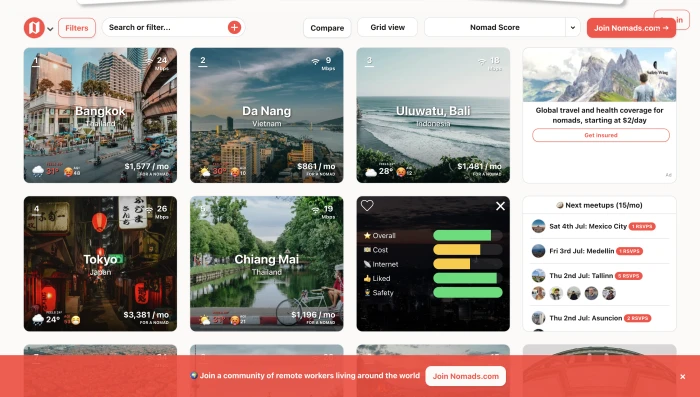
Nomad List is the cleanest case of aggregation plus freshness. Each of its thousands of city pages stacks a dozen data points a traveler actually cares about: cost of living, internet speed, weather, safety, air quality, and community reviews on top. The trick is the mix of real-time data (current temperature, current air quality) with historical data and genuine user reviews, which is why a page for one city reads nothing like a page for another, and why it captures long-tail queries like "cost of living in Chiang Mai" or "best cities for digital nomads with fast internet." The lesson: when your data is aggregated from elsewhere, the value lives in the combination, the freshness, and the human layer on top, not the raw numbers.
Wise took the humblest pattern and made it work by making each page do something. Its currency pages target queries like "usd to eur," and instead of a wall of text, each one hands you a working conversion tool, a chart of the rate over time, a short guide, and links to related currency pages. The page is not describing a currency conversion. It is performing one. The lesson: sometimes the unique value is not information at all, it is a tool or an interaction the searcher came to use.

Tripadvisor and Yelp are worth a nod for a fourth pattern, faceting. Tripadvisor does not just have "restaurants in Chicago." It has "best Italian restaurants in Sydney," "restaurants in Chinatown NYC," and "vegan restaurants in downtown LA," layering cuisine, neighborhood, and attributes onto the base location to match ever more specific intent. That is the same three-layer template we are about to dissect, just run across two or three variables at once. The lesson: once the base pattern works, you can multiply it by attributes that map to real, distinct searches, and only those.

Four sites, four lessons, one common thread: every single one of those pages has something on it that is genuinely useful and genuinely hard to copy. Hold that thought, because it is the entire rest of this guide.
Before we get into the fun mechanical stuff, I owe you the conversation that most guides skip because it does not help them sell a course.
"Should you do programmatic SEO" has roughly the same answer as "should you take out a loan": it depends entirely on whether you have something worth financing. Programmatic SEO is a distribution mechanism for value you already possess. It is not a value-creation shortcut. If you feed it nothing, it will very efficiently distribute nothing, at scale, in a way Google now actively hunts.
There are three questions that decide whether you are holding leverage or a liability.
First, do you have a data moat? Something to put in those thousand rows that is genuinely useful and not trivially copyable. Your own product data, proprietary pricing, aggregated statistics you computed, real inventory, first-hand tested results. If your "data" is just a list of city names and some spun sentences, you do not have a data set, you have a permutation generator, and that is a different and much sadder business.
Second, is there real search demand across the pattern? Not one head term with volume, but the long tail beneath it. "[Job title] salary in [city]" works because people search thousands of those combinations every month. "[Obscure product] reviews in [tiny town nobody searches]" does not, and building it anyway produces ten thousand pages competing for a total of zero clicks.
Third, does each individual page clear the bar of deserving to exist on its own? This is the one people fail. If a single page in your set, viewed in isolation, would make a reasonable person say "yeah, this is useful," you are fine. If it would make them say "why does this page exist," you have a problem that multiplies by however many rows you have.
Pass all three and programmatic SEO is some of the best leverage in marketing. Fail any of them and you are building a very organized landfill. I have seen the landfill. It does not rank for long.
Now the architecture, which is where this whole discipline actually lives or dies.
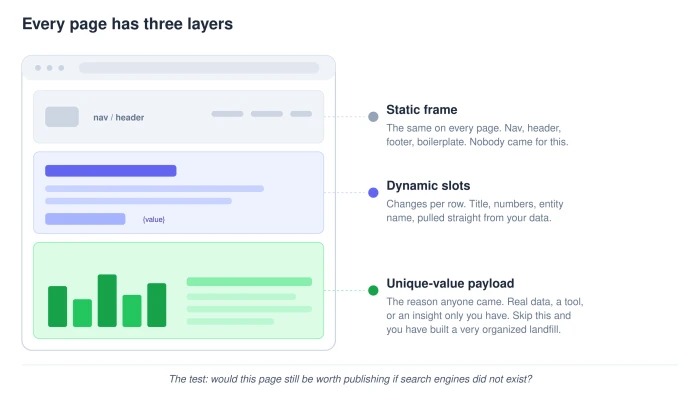
Think of every programmatic page as three layers stacked on top of each other. Get the stack right and you can generate a million pages that each feel intentional. Get it wrong and you generate one page a million times.
The first layer is the static frame. The parts that are identical on every page: the navigation, the header, the general structure, the footer, the boilerplate that explains what this section of the site is. This is the skeleton. It is the same on all of them, and that is fine, because nobody came for your footer.
The second layer is the dynamic slots. The variables that change per row: the title, the H1, the specific numbers, the entity name, the local details. This is the muscle, and it is pulled straight from your data source. "Cost of living in {city}" where {city} swaps out. The salary figure that changes. The integration steps that differ per tool pairing.
The third layer is the one that separates a real page from a doorway, and it is the one thin templates omit: the unique-value payload. The genuinely distinct substance that makes this specific page worth landing on. Real data specific to this entity. A computed insight. A relevant comparison. Actual specifics a searcher for that exact query needed. This is the reason anyone came, and it is the reason Google keeps the page indexed.
Skip the third layer and you have built the internet equivalent of a mail merge. The skeleton and the muscle are not the point. The payload is the point. When I audit a programmatic project that tanked, ninety percent of the time the diagnosis is the same: layers one and two were beautiful, and layer three was three sentences of AI filler stretched around a keyword.
Here is the test I give teams, and it fits on a sticky note. For any single page in your set, ask: would this page still be worth publishing if search engines did not exist? If the honest answer is yes, you have a payload. If the honest answer is "well, no, it is just here to rank," you do not have a page, you have a liability with a URL.
One practical habit before you build anything: wireframe the page first. Sketch the actual layout, every content block, every data point it needs, on a whiteboard or in a design tool, so you know exactly what your data has to supply. It sounds fussy, but the teams that skip straight to the spreadsheet always discover halfway through that their template needs a field their data does not have. Design the page, then go get the data it demands, not the other way around.
I cannot overstate this. In programmatic SEO, the data source is not a supporting character. It is the entire show. The template is just how you dress the data for a night out.
Your data can come from a few honest places. Your own product generates data as a byproduct of existing, which is the best source because nobody else has it: usage stats, pricing, inventory, connections, catalog. Public data sets and government sources give you raw material you can enrich (raw is the operative word, because republishing a public data set unchanged is one of the things that gets pages flagged). APIs let you pull structured information at scale. And aggregation-plus-analysis, where you gather scattered information and add a computed layer on top, can create genuine value that did not exist in any single source. The keyword in all of those is added. Google's own guidance singles out "stitching or combining content from different web pages without adding value" as a violation. The value you add is your whole defense.
Practically, your data set is a table and it should be treated like production infrastructure, because it is. Every row becomes a page. Every column becomes a slot in the template. Which means every gap in your data becomes a hole in a live page, and every duplicate row becomes a duplicate page, and every stale figure becomes a wrong answer served to a stranger.
So the boring work matters more than the template design. Deduplicate ruthlessly, because near-identical rows produce near-identical pages, and near-identical pages at scale are precisely the pattern detection systems are tuned to catch. Fill the gaps or exclude the incomplete rows, because a page with three empty sections looks exactly as thin as it is. Keep it fresh, because programmatic pages rot quietly: a salary page from three years ago is not neutral, it is misinformation with good formatting. Garbage in does not just give you garbage out. It gives you garbage out ten thousand times, indexed, with your domain's name on it.
This is where search intent stops being a buzzword and becomes the load-bearing wall.
Programmatic keywords follow patterns. A head term plus a modifier, repeated across a data set. "{Tool} integrations." "{Tool A} vs {Tool B}." "Best {product} for {use case}." "{Software} alternatives." "{Job} salary in {city}." "{Template type} template." The modifier is the pattern, and the data set fills in the specifics.
The rookie move is to treat this as a permutation exercise. Take a list of tools, take a list of use cases, multiply them together, generate every combination. Congratulations, you now have forty thousand pages, of which maybe four thousand correspond to something a human being has ever typed into a search bar. The other thirty-six thousand are dead weight that dilutes your site and gives detection systems a lovely uniform pattern to notice.
The discipline is to validate demand before you generate, not after. Every modifier pattern needs to map to real search volume across enough of the data set to justify building it. This is where actual keyword research earns its keep, using seed patterns to discover which combinations people search and pruning the combinations they do not. You are not looking for one keyword. You are looking for a pattern with a populated long tail underneath it.
There is a cheap way to de-risk the entire bet before you build a single page, and more operators should use it: run a small paid-search test. Take a sample of your target queries, put a modest Google Ads budget behind them pointing at one or two manually built prototype pages, and watch whether they actually convert. A few hundred dollars spent finding out that nobody clicks, or that the clickers never buy, is a bargain next to generating ten thousand pages for a pattern with no return. If the prototype earns its keep, scale it. If it does not, you just saved yourself a year of maintaining pages that were never going to pay.
But volume is only half of it, and the more important half is the one people ignore: every modifier pattern implies a specific intent, and the page has to match that intent or the whole thing collapses. "{Tool A} vs {Tool B}" is a comparison intent, so the page owes the reader an actual comparison, not two paragraphs of preamble and a signup button. "Best {product} for {use case}" is a recommendation intent, so the page owes a genuine, opinionated pick. "How to {task} in {tool}" is an instructional intent, so it owes real steps. When the modifier promises one thing and the page delivers keyword-stuffed nothing, you have not built a landing page. You have built a doorway, and doorways have a specific and unpleasant fate, which brings us to the next section.
Location pages are the most abused pattern in all of programmatic SEO, so they deserve their own reckoning.
Here is Google's actual position, straight from the spam policies, and I am quoting because it matters. Google explicitly calls out as doorway abuse "having multiple domain names or pages targeted at specific regions or cities that funnel users to one page," and "creating substantially similar pages that are closer to search results than a clearly defined, browseable hierarchy." Read that twice if you are about to build location pages.
Translated: a location page that changes only the city name is not a location page. It is the same page wearing four hundred different hats, and Google has seen that particular magic trick since roughly 2011.
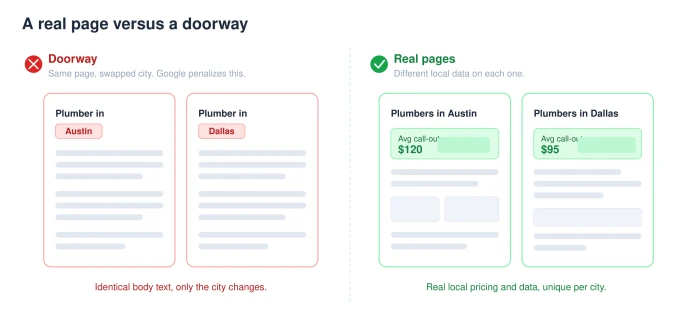
"Plumber in Austin," "plumber in Dallas," "plumber in Houston," all with identical body copy and a swapped city, is the textbook doorway pattern. It is not a clever loophole. It is the specific thing the policy names.
The fix is not to abandon location or use-case pages. Sites do them brilliantly. The fix is to make each one genuinely, substantively different, and the only way to do that is with data that actually varies by location or use case. A real location page has local specifics: actual local pricing, real local inventory, genuine area data, region-specific detail that a searcher in that city needed and could not get from the generic page. A real use-case page has substance specific to that use case: the actual workflow, the real configuration, the specific outcomes, not a find-and-replace of "use case" into a template.

The test again, sharpened for this pattern: if you put two of your location pages side by side and covered up the city name, could a reader tell them apart? If yes, you have real pages. If no, you have doorways with good intentions, and intentions are not an indexing signal. The differentiator is not tone or synonyms or a rephrased intro. It is materially different information per page. No data that varies by location means no location pages, full stop, and I would rather tell you that now than let a core update tell you later.
Generate a thousand pages and, by default, you have created a thousand orphans. Pages nobody links to, that sit in no hierarchy, that Google struggles to find and struggles to justify. A pile of pages is not a site. It is a landfill. What turns the pile into a library is internal linking, and this is the step most programmatic projects treat as an afterthought and then wonder why nothing gets indexed.
Remember that phrase from Google's doorway definition: "a clearly defined, browseable hierarchy." That is not a throwaway line. It is Google telling you exactly what it wants to see, which is structure, not sprawl. Your internal linking is how you prove your thousand pages form a coherent, navigable thing rather than a keyword dump.
A few principles carry most of the weight. Build a hub-and-spoke structure where category or pillar pages link down to the individual programmatic pages, and the programmatic pages link back up and across to their siblings. This gives every page a place in a hierarchy and distributes authority from your stronger pages down into the long tail where it is needed. Add contextual cross-links between related pages, the "X" page linking to the relevant "Y" page, so the network reflects genuine relationships rather than a flat list. Use breadcrumbs so both users and crawlers can see the hierarchy at a glance. And keep an accurate XML sitemap, because at programmatic scale you cannot rely on organic discovery alone.

The goal is that any page in your set is reachable in a couple of clicks from somewhere authoritative, and that the link graph looks like a designed structure rather than a shaken bag of URLs. Do this well and Google crawls efficiently, understands the relationships, and passes equity where it counts. Skip it and half your pages never get indexed, which, depending on how you feel about your data set, may occasionally be a mercy.
People always ask what tools they need, so here is the honest map. There is no single correct stack, only three jobs that always have to get done: hold the data, generate the pages from a template, and keep the two in sync. Pick whatever does those three jobs at your scale.
The data layer is your source of truth, the table where every row is a page. For a few hundred pages, a Google Sheet or an Airtable base is genuinely enough, and Airtable has the edge because it behaves like a real database and non-technical people can actually use it. For medium projects, graduate to a proper SQL database. For enterprise-sized sets, a data warehouse like BigQuery or Snowflake. The tooling matters far less than the discipline we already covered: clean, deduplicated, complete, current.
The generation layer turns rows into pages against your template, and this is where your CMS decides your path. On WordPress, an import plugin such as WP All Import will take a CSV export of your sheet, map each column to a field (title tag, H1, meta description, body), and generate the pages in one run. On Webflow, you build a CMS collection whose fields mirror your data, then populate it with a sync tool. If you have developers, a static-site or framework approach (Next.js, Astro, and the like) that reads from your data source at build time is the most flexible and the fastest-loading option, which is why most large programmatic sites are built that way rather than on a plugin.
The sync layer keeps live pages current as your data changes, and it is the part beginners forget. A one-time CSV import is fine for static facts, but if your data updates (prices, availability, anything real-time), you want a two-way sync between your data source and your CMS so a change in the table becomes a change on the page automatically. Dedicated sync tools handle the common Airtable-to-Webflow path, and plain APIs handle it for custom builds. If you want the whole pipeline to run on autopilot, from keyword to published page, that is exactly where an n8n SEO automation workflow earns its keep, and pulling the metrics side from the Ahrefs API keeps the data honest.
Two supporting pieces round it out. If your pages need custom images at scale, image-generation tools that plug into your data source can stamp out a unique image per row. And your SEO plumbing (structured data, an accurate XML sitemap, clean canonical tags) has to be templated too, because at a thousand pages nobody is adding schema by hand.
None of this is the hard part, and I want to be clear about that. The tools are a solved problem, and you can stand the whole pipeline up in a week. The hard part remains exactly what it has been this entire guide: having data worth publishing and making each page worth the click. The stack just moves your value onto the internet. It cannot create the value for you.
Now the part the March 2026 survivors learned the hard way, and the reason I keep bringing up that update.
Sit with that last clause. No matter how it's created. Google has said, repeatedly and in as many words, that it does not care whether a human or a machine made the page. A person hand-typing two thousand cookie-cutter pages violates the policy exactly as much as a script that generates them overnight. The crime is not the tool. The crime is volume without value, aimed at rankings.
This reframes quality control from a nice-to-have into the actual product. At programmatic scale you cannot read every page, so QC has to be systematic, and it looks like this.
Set a thin-page threshold and enforce it mechanically. Define what "enough unique value" means for your set (a minimum amount of genuinely distinct, data-backed substance) and simply do not publish rows that fall below it. It is better to ship four hundred strong pages than four thousand where nine tenths are filler dragging down the tenth.
Publish in controlled batches, not all at once. Roll out a few hundred pages, watch how they index and perform, confirm they are earning impressions and holding, and only then release the next batch. A staged rollout means that if a pattern is weak, you find out at four hundred pages instead of forty thousand. It is the difference between a bruise and a catastrophe.
Keep the weak pages behind noindex until they earn their way in. There is nothing wrong with generating a page and holding it back. Index the ones with real substance, noindex the ones that are still thin, and revisit as your data improves.
Then prune, continuously and without sentiment. Programmatic SEO is not fire-and-forget. Watch which pages get impressions and which are inert, and cut or consolidate the dead weight. Detection systems evaluate patterns across your domain, and a large mass of thin, inert pages is itself the pattern. Trimming them is not just tidying, it is protecting the pages that work from the company they keep.
The mental model that keeps you safe is simple. Every page you publish is a small bet that this specific page helps someone. Make a thousand good bets and you have a compounding asset. Make ten thousand bad ones and you have handed Google a clean, uniform signal that says "this section exists to game rankings," and its systems are very, very good at reading that signal now. Volume was the strategy in 2019. In 2026 it is the liability. Value is the only thing that scales safely.
I would be dodging if I did not address this directly.
AI has made the mechanical part of programmatic SEO nearly free. You can generate the copy for a thousand pages in an afternoon. This is genuinely useful and also genuinely the problem, because AI has made it trivially easy to produce the precise thing Google is now hunting: large volumes of plausible-looking pages with no real substance underneath. The barrier to creating a landfill has never been lower, which is exactly why the landfills got bulldozed in March.
The honest way to use AI here is as a scaling layer on top of real value, never as a substitute for it. The value has to come from somewhere AI cannot invent: your data, your product, your first-hand testing, a computed insight, information gain that did not exist before you created it. AI can then help express that value at scale, format it, adapt it per entity, make a thousand pages readable. That division of labor is the whole game. Data and genuine substance provide the reason the page deserves to exist; AI provides the throughput. Reverse that (ask AI to invent the substance and just add your keywords) and you have automated your own demotion. This is the same line that separates durable AI SEO from the stuff that gets penalized.
It also matters that search itself has changed. With AI Overviews and generative answers now sitting on top of results, a thin page that merely restates common knowledge has even less reason to earn a click, because the machine already summarized common knowledge above it. The pages that still win are the ones with something the summary cannot reproduce: your specific data, your specific experience, your specific numbers. Which is, conveniently, the same thing that keeps you safe from the spam policies. Genuine value is not one requirement among many anymore. It is the requirement, and everything else is logistics.
Pulling it together, here is the sequence I would actually follow, in order, because order matters.
Notice that "generate the pages" is step four or five, not step one. The people who lead with generation are the people writing recovery-request emails a year later.
If you forget everything else, keep this. Programmatic SEO is leverage, and leverage is neutral. It multiplies whatever you point it at. Point it at a real data moat and genuine search demand, with pages that each deserve to exist, and it becomes some of the most efficient organic growth available to a SaaS or content team. Point it at permutations and filler and the hope that Google will not notice, and it becomes a very organized way to get penalized.
The technique is not the risk. The technique is fine. The risk is doing it without anything worth scaling, and dressing that absence up in a nice template. Build pages that help people, at scale, using data only you have. That is the entire discipline. Everything in this guide is just the plumbing.
Programmatic SEO is one piece of a larger automation system. These guides go deeper on the parts you will need to actually build it:
Generating many search-optimized pages at scale from a single template and a structured data set, one page per data entry, instead of writing each page by hand.
You build a page template with static parts and variable slots, connect it to a data source where each row is a topic, and generate one page per row, then wire them together with internal links and publish in controlled batches. The data set and the unique value on each page are what make it work.
No, but thin programmatic SEO is. The 2026 spam enforcement targeted mass-produced pages with no real value, and legitimate programmatic sites with genuine data and per-page substance were largely fine. The technique is alive; the shortcut version is not.
It depends on your stack. You need something to hold the data (a spreadsheet or database), a way to generate pages from a template (a CMS with programmatic support, a static-site setup, or a dedicated programmatic SEO platform), and increasingly an AI layer to help express the value at scale. Pick tools that make your data and unique value easy to manage, since that is the part that actually matters.
Start by honestly checking whether you have a useful, hard-to-copy data set and real search demand across a keyword pattern. If both are true, validate the intent behind the pattern, design a template with a genuine value layer, and publish a small batch before scaling. If either is missing, invest in regular content instead.
As many as you have genuinely distinct, useful pages to publish, and not one more. The right number is dictated by your data and real demand, never by an ambition to hit a page count. Ship the strong ones and hold back the thin ones.
Keep Reading

A checksum error means data failed its integrity check. Which one you...

A buyer's guide to answer engine optimization services in 2026: what A...

An honest three-way comparison of Frase, Surfer SEO, and Writimate acr...

Realistic programmatic SEO timelines: indexation in weeks 0 to 4, firs...

A conversion-focused guide to programmatic SEO for SaaS: the page type...

An honest 2026 Surfer SEO review: Content Editor, Surfer AI, pricing,...