
AI SEO is the practice of using artificial intelligence — large language models, embeddings, and automation — to research, produce, optimize, and measure organic content, while optimizing that content so both Google and AI answer engines will surface and cite it. It is not "using ChatGPT to write blog posts faster." It is a complete rethinking of how a content operation works, built on one principle: AI handles the volume and the structure, humans handle the judgment and the voice, and the system connects the two so nothing ships unchecked.
This guide is the hub for everything we've published on the subject. It covers what AI SEO is, why the ground shifted, the two halves of a working system (an automation layer and a content-quality layer), and how to measure results in a search landscape where ranking first no longer guarantees a click. Each section links out to the deep-dive guide that covers it in full.
Why AI SEO Exists Now
The search bar stopped being a list of links. Google's AI Overviews now appear on a large and growing share of queries — estimates for early 2026 range from roughly a quarter to nearly half of all searches depending on the tracker and vertical, and higher still for informational queries in health, finance, and tech. Alongside Google, people now ask ChatGPT, Gemini, Perplexity, and Claude directly. The first thing a searcher sees is often a synthesized answer, not your homepage.
That has two measurable consequences. First, click-through on informational queries where an AI Overview appears has dropped sharply — one widely cited Seer Interactive dataset showed position-one CTR on those queries collapsing before partially rebounding, and the gap between AI-Overview-present and AI-Overview-absent queries is now the environment SEOs plan around. Second, being cited inside the AI answer has become its own form of visibility: brands cited within an AI Overview earn meaningfully more clicks than uncited brands on the same result page. Ranking first and getting cited are now two different jobs.
Here's the trap most teams fall into. They either dismiss AI SEO as hype and keep doing 2022 SEO, or they abandon fundamentals and chase AI-visibility tactics with no technical or content foundation underneath. Both lose. AI systems still crawl the web, still index it, and still pull from it — without solid traditional SEO as the base, there's nothing for AI visibility to build on. Ahrefs' analysis found that the large majority of URLs ChatGPT cites are pulled directly from search. The winning approach isn't a choice between two strategies. It's one integrated strategy with two layers.
AI SEO, GEO, and AEO: What the Acronyms Actually Mean
The terminology around this shift multiplies fast, and most of it describes overlapping work. Three terms matter.
AI SEO uses AI tools to do traditional SEO better — faster keyword research, automated clustering, quicker drafts. The destination is still Google's ranked results. Generative Engine Optimization (GEO) is the practice of structuring content so large language models cite it as a trusted source inside a generated answer — in ChatGPT, Gemini, Perplexity, Claude, or Google's AI Overviews. Answer Engine Optimization (AEO) is the closely related discipline of formatting content to be the answer: a direct response in the first sentence, question-style headings, FAQ and HowTo schema, scannable structure.
In practice GEO and AEO overlap by roughly 80% and share almost all their tactics, so treating them as one body of work is fine for most teams. The important relationship is hierarchical, not competitive: SEO is the foundation and GEO/AEO is the layer on top. A site that fails the basics — slow, unstructured, thin — will fail GEO too, because AI systems crawl and evaluate the same signals. Get the fundamentals right and you're set up for both. One caution the research makes explicit: surface-level SEO tricks like paid backlinks, keyword stuffing, and thin content don't just underperform in AI search, they actively hurt your citation chances.
The Principle That Holds the Whole System Together
Every durable AI SEO workflow runs on the same division of labor: AI is fast at ideas and structure and weak at facts and numbers. Get that boundary right and the system compounds. Get it wrong and you ship confident nonsense at scale.
The adoption data backs this up. The vast majority of SEO professionals have integrated AI into their workflows, and most marketers report editing AI output before publishing rather than shipping it raw. The productivity gain is real — surveys put the time saved at anywhere from an hour a day to twelve-plus hours a week — but that time is meant to move to strategy, editing, and distribution, not to disappear into more unreviewed output. AI does the heavy lifting: keyword expansion, clustering, gap analysis, intent classification, first-draft briefs. Humans do the judgment: business context, brand voice, SERP interpretation, and the final call on whether a page is actually good. Skip either side and you lose.
A Semrush study of 481 marketers found that only about a fifth have fully integrated their SEO and AI-search efforts across strategy, execution, and reporting — and that the ones who have are the ones seeing more traffic and leads. The strategy is widely understood. The operating model behind it is where almost everyone is still behind. That operating model is what the rest of this guide lays out.
The Two Halves of a Working AI SEO System
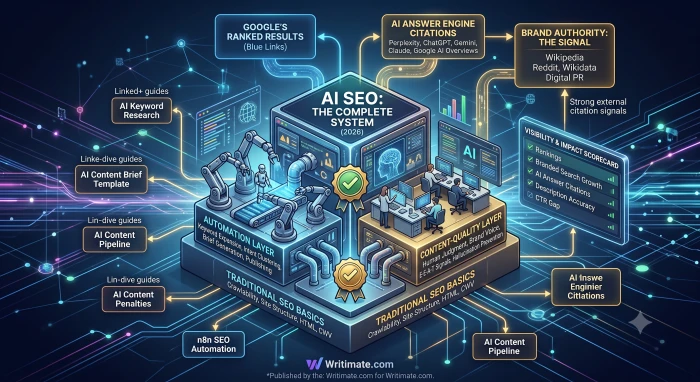
A complete AI SEO system has two sub-systems that most teams build separately and never connect. One is the automation layer — the plumbing that moves a keyword through research, drafting, and publishing without manual copy-paste between six tools. The other is the content-quality layer — the strategy, briefs, model choices, and editorial checks that decide whether what gets published is worth publishing. The automation makes you fast. The quality layer makes you rankable. You need both, wired together.
Half One: The Automation Layer
Automation multiplies throughput wherever the work is repeatable and rule-based: keyword clustering, brief generation, internal-linking suggestions, schema drafting, on-page checks, and publishing. Done well, it collapses time-to-publish so you can capture seasonal spikes and emerging topics before competitors, and it frees your scarce experts to focus on the parts that need a human.
The clearest way to see this concretely is a real pipeline. Our guide to building an end-to-end AI SEO content pipeline walks through the full chain — keyword to published article in about ten minutes of machine time, plus twenty minutes of human review — stage by stage. For teams that want to own the plumbing themselves rather than use an all-in-one tool, we cover the same workflow built in n8n in the complete n8n SEO automation guide, which connects keyword research through to a published WordPress post.
That n8n build breaks into a few reusable parts, each covered in its own guide. Connecting your data source is step one — the Ahrefs API and n8n integration guide covers credentials, rate limits, and pulling live volume and difficulty. The research brain of the pipeline is covered in how to build an n8n keyword research agent with the Ahrefs API and GPT. The publishing end — turning a finished draft into a live post with meta tags, schema, and images — is in the n8n WordPress automation guide. And if you're deciding which automation platform to build on in the first place, our comparison of n8n, Zapier, and Make for SEO teams covers the trade-offs.
The one guardrail that matters across all of this: automation without judgment scales your mistakes as efficiently as your wins. Every credible source on the subject flags the same red line — be skeptical of any tool promising fully automated SEO with no human oversight. The pipeline should move work to a human at the points where a human decision matters, not remove the human entirely.
Half Two: The Content-Quality Layer
Speed is worthless if the output can't rank. Google rewards content quality and intent match above authorship method — it does not penalize content for being AI-assisted, but it does penalize thin, inaccurate, or unhelpful content regardless of how it was made. So the quality layer is where a working system spends its human hours.
It starts before a single word is written. The single highest-leverage document in the whole system is the brief, because a good brief is what stops a model from drifting, padding, or inventing facts. Our SEO content brief template for AI covers how to specify target keyword, intent, required headings, facts to include, facts to avoid, and the QA checklist that catches problems before they reach a page.
The model you draft with matters too, though less than people assume. We ran a head-to-head in our GPT-4 vs Claude comparison across a 50-article workflow test, covering outline quality, factual accuracy, heading structure, and how much editing time each model actually costs — the metric that determines real throughput.
Two failure modes threaten the quality layer specifically, and both have dedicated guides because both are common and both are fixable. The first is the fear that stops teams from using AI at all: does Google penalize AI content in 2026? walks through what Google actually evaluates — helpfulness, originality, accuracy, and user value — and why responsible AI use with human review is safe while mass, unreviewed publishing is not. The second is structural and unique to high-volume pipelines: content cannibalization, where a pipeline with no memory quietly generates several pages targeting the same intent and they compete against each other. That guide covers the keyword-map gate, pre-publish intent checks, and consolidation rules that keep a fast pipeline from eating its own rankings.
The Foundation Under Both Halves: Keyword Research and Topic Clusters
Both sub-systems rest on the same foundation: knowing what to write and how the pieces fit together. This is the seam where the automation layer and the quality layer meet, because the research that feeds an automated pipeline is the same research that a strategist uses to plan a cluster.
Modern keyword research has moved from chasing volume to mapping intent. Search volume alone no longer tells you enough — an estimated 15% of daily searches are brand new, so the highest-intent long-tail queries your buyers type may show little volume anywhere. AI's real contribution is reading intent at scale by analyzing the live SERP for each keyword rather than the words in it, then clustering terms by what the searcher actually wants. Our AI keyword research guide covers the full method — expand, cluster by intent, validate against real data, and prioritize by business fit.
The organizing structure on top of that research is the topic cluster: one broad pillar page covering a subject, supported by focused spoke pages that each answer a narrower question and link back to the hub. This matters more under AI search than it did before, because AI systems increasingly evaluate authority at the cluster level, not the individual keyword level — they surface sites that visibly own a whole territory, not sites that mention a phrase once. This very guide is the pillar of a cluster; every guide it links to is a spoke that goes deeper than a pillar can. That architecture is the point: comprehensive coverage that reinforces itself instead of competing with itself.
The Technical Layer: Making Your Content Machine-Readable
None of the content strategy matters if crawlers — Google's and the AI engines' — can't cleanly access and parse your pages. The technical foundation for AI SEO is mostly the same foundation as classic SEO, with a few additions.
The classic fundamentals still apply: fast pages that meet Core Web Vitals thresholds, mobile readability, a clean site structure with strong internal linking, essential content served in HTML (use server-side rendering if you're on a JavaScript framework), and an XML sitemap. Structured data does double duty in 2026 — schema markup helps Google display rich results and helps AI systems parse and extract your content reliably. The schema types that matter most for answer engines are Article, FAQPage, HowTo, Organization, Person, and Speakable. Google's Rich Results Test lets you audit both at once.
The AI-specific additions are two. First, allow the AI crawlers you want in your robots.txt — GPTBot, ClaudeBot, PerplexityBot, Google-Extended, and others — since blocking them removes you from the pool those engines draw on. Second is llms.txt, an emerging file at your site root that acts like a sitemap for LLMs, pointing them at your most important, canonical pages. Be realistic about it: llms.txt is not yet universally adopted and one large 2026 dataset found little evidence it currently moves citations, while domain authority clearly does. Treat it as low-cost insurance, not a priority — deploy it, but don't expect it to substitute for the harder work of authority.
Brand Authority: The Most Underrated Signal in AI Search
Here is the finding almost everyone under-invests in. In a 2026 survey of digital marketers, only 19% named brand authority as a strategic priority — yet 81% were already doing backlinks and digital PR as routine work, without recognizing it as the strategy it is. That gap matters, because brand authority is arguably the single strongest signal AI systems use when deciding which brands to surface.
The mechanism is well documented. Multiple 2025–2026 studies found that LLMs preferentially cite sources that are already heavily cited elsewhere — a Matthew effect where existing web presence compounds into more AI citations. For LLM-native answers (Claude or ChatGPT drawing on training data rather than live search), your presence across the web — forums, documentation, news, reputable blogs — is what determines whether the model knows you exist at all. Brand popularity, measured crudely by search volume, correlates strongly with mentions in AI chatbots.
The practical implication reframes link building. AI-assisted digital PR, earning mentions on the sources LLMs trust (Wikipedia, Reddit, established industry publications, structured data sources like Wikidata and Crunchbase), and keeping your entity representation consistent across the web are no longer just "off-page SEO." They are how you become a brand the answer engines are willing to name. For smaller brands this is the hill to climb, and it's why brand authority can't be treated as background noise — it has to be a deliberate, funded part of the system.
Measuring AI SEO: Rankings Are No Longer the Whole Scorecard
The most common mistake in AI SEO is investing in the strategy and then measuring it the old way. A keyword position in Google's blue links tells you nothing about whether ChatGPT cites you, whether you appear in an AI Overview, or how you're positioned against competitors inside a generated answer. A page ranked seventh can appear in an AI Overview while the page ranked first does not, because citation depends on how cleanly the content maps to the answer being constructed.
So the scorecard expands. Alongside rankings, traffic, CTR, and conversions, a 2026 AI SEO program tracks presence in AI answers — whether your content shows up in AI Overviews and answer engines — plus branded search growth as a downstream signal of AI visibility, and the accuracy of how you're described when you are mentioned. In the Semrush study, more than a third of marketers said competitors are cited more often than they are, and nearly a third said their brand is described inaccurately in AI answers. Those are measurement problems as much as content problems, and you can't fix what you don't track.
To make content extractable for those answer engines, the structural fundamentals are simple and consistent across every credible source: answer the core question directly and early, use clear headings and well-structured sentences, keep facts accurate and fresh, and demonstrate genuine expertise and first-hand experience — the E-E-A-T signals that AI systems increasingly use as a trust filter. The same fundamentals that earn a rank increasingly earn a citation, which means you're building one asset, not two.
The AI SEO Tool Stack
No single tool does everything well in 2026, and the research is consistent that the best results come from a deliberate stack rather than one platform that claims to do it all. The pattern most effective teams converge on has three layers.
The first is a comprehensive data platform — Ahrefs or Semrush — for keyword data, backlink analysis, rank tracking, and competitive research. This is your source of truth for the numbers, and it's what your automation should validate against so you never act on a hallucinated volume. The second is a content and optimization layer that turns that data into briefs and drafts, whether that's a dedicated optimization tool or an integrated pipeline. The third, newly essential in 2026, is an AI-visibility tracker that shows where your brand appears inside answer engines, because traditional rank tracking is blind to whether ChatGPT or Perplexity is citing you.
The selection rule is to start from your highest-pain workflow, not from a feature list. Most professionals get the best return by combining one comprehensive platform with two or three specialized tools aimed at their specific bottlenecks, then integrating those into existing processes rather than bolting on entirely new ones. Two red flags are worth repeating: be wary of any tool promising fully automated SEO with no human oversight, and of any vendor that can't explain how its AI actually works. The goal of a stack is leverage for your judgment, not a replacement for it.
Where to Start
If you're building an AI SEO system from scratch, the order that works is: research first, structure second, production third, measurement throughout. Start by mapping your intent-based keyword clusters, decide your pillar-and-spoke architecture, then stand up a production pipeline with human review built into the points that matter, and instrument both traditional and AI-answer visibility from day one. Each of those steps has a full guide linked above.
The teams pulling ahead in 2026 aren't the ones using the most AI or the ones resisting it hardest. They're the ones who built an actual system — automation for speed, human judgment for quality, and a cluster architecture that compounds authority with every publish. That's the whole game, and everything else on this site is a piece of it.
Frequently Asked Questions
Is AI SEO the same as regular SEO? No. AI SEO uses AI tools to do SEO faster and more accurately, but it also adds a second goal: getting cited inside AI-generated answers, not just ranking in blue links. It builds on traditional SEO rather than replacing it — the fundamentals of crawlability, quality content, and authority still decide whether AI systems will surface you.
Does Google penalize AI-generated content? Google penalizes low-quality content regardless of how it was produced. Thin, inaccurate, or unhelpful pages risk ranking drops whether written by a human or a model. AI-assisted content with genuine human review, accuracy, and original value is not penalized. The full breakdown is in our guide on whether Google penalizes AI content.
What's the difference between GEO and AEO? They overlap by roughly 80%. GEO (Generative Engine Optimization) is the broader practice of getting cited across any generative AI surface; AEO (Answer Engine Optimization) focuses specifically on being the direct answer, using answer-first formatting and schema. For most teams the tactics are the same and the distinction is academic.
Do I still need traditional keyword research? Yes, but the emphasis shifts from volume to intent. You still validate demand against real data, but the higher-leverage work is clustering keywords by what the searcher actually wants and mapping each cluster to one page. Our AI keyword research guide covers the current method.
How fast can an AI SEO pipeline actually publish? A well-built pipeline can move from keyword to a drafted, optimized article in around ten minutes of machine time, with roughly twenty minutes of human review before publishing. The human review is not optional — it's the step that keeps quality and accuracy intact. The full pipeline is documented here.
How do I measure AI SEO if rankings don't tell the whole story? Track traditional metrics (rankings, traffic, CTR, conversions) alongside AI-answer visibility — whether you appear in AI Overviews and answer engines, how accurately you're described when mentioned, and branded search growth as a downstream signal. A page can rank seventh and still be cited in an AI Overview while the first result isn't, so the two need separate measurement.
Writimate is built to run this entire system in one place — from intent-based keyword research through drafting, optimization, and cannibalization checks — so the division of labor that makes AI SEO work is built into the tool rather than stitched together by hand. See what fits your workflow on the Writimate pricing page.


